3.14 – Stocks vs Bonds: How Should You Allocate Between Them?
Stocks Can Drive Long-Term Growth — But Bonds Can Change How Much Risk You Need to Take
Imagine two investors each have a $1 million investment portfolio. The first holds:
$900,000 Stocks
$100,000 Bonds
The second holds:
$600,000 Stocks
$400,000 Bonds
Both investors might describe themselves as long-term investors.
Both might own broadly diversified portfolios.
But their portfolios will behave very differently. The first investor has:
more capital participating when stock markets rise
greater exposure when equity markets fall
less portfolio stability from bonds
greater dependence on equity returns for long-term outcomes
The second has:
less exposure to stock-market growth
more capital allocated to potentially stabilising assets
but also less capital participating in long-term equity compounding
This creates an important portfolio-construction question:
How Much Should You Allocate to Stocks and Bonds?
The obvious answer might appear to be:
More Stocks for Growth
and:
More Bonds for Safety
But the decision is more complicated than that. Stocks and bonds don’t simply represent:
Risky Assets
and:
Safe Assets
They perform different jobs.
Stocks generally provide ownership in businesses and the potential for long-term capital growth.
Bonds represent lending capital to governments or companies in exchange for interest and repayment under defined terms.
Their return patterns, risks and roles within a portfolio are therefore different. That matters because the appropriate allocation isn’t determined by one universal percentage.
A 35-year-old investor with stable employment income and no planned withdrawals may have very different reasons for holding bonds from a 70-year-old investor funding retirement spending.
But age alone doesn’t determine the answer either. Two investors of exactly the same age may have very different:
The real question therefore isn’t simply:
“What percentage should I put in bonds?”
It is:
An investor may hold bonds to reduce portfolio volatility.
Another may use them to support future withdrawals.
Another may want capital available for rebalancing during equity-market declines.
And another may have such a long horizon and high risk capacity that a substantial bond allocation serves relatively little purpose.
The allocation percentage is the outcome. The role of each asset class should come first.
In this guide, we’ll examine how stocks and bonds work, how they affect portfolio risk and return, whether traditional allocations such as 60/40 still make sense, how age and investment horizon should influence the decision, when an all-stock portfolio may be reasonable and how Structured Compounders deliberately allocate between growth and stability.

Who This Guide Is For
This guide is designed for long-term investors who want to think more deliberately about how stocks and bonds should work together within their investment portfolio. It will be particularly valuable if you:
are deciding whether bonds belong in your portfolio
currently invest almost entirely in stocks
already hold both stocks and bonds but aren’t sure why you chose the current percentages
want to understand the trade-off between growth and portfolio stability
are considering a traditional allocation such as 60/40
are unsure whether your age should determine your stock-bond allocation
are approaching retirement or beginning portfolio withdrawals
want to understand how bonds can affect portfolio drawdowns
want to distinguish genuine risk capacity from simply feeling comfortable with volatility
want clearer rules for rebalancing between stocks and bonds
want a more structured approach to asset allocation
are progressing towards becoming a Structured Compounder
The central question changes as investors become more sophisticated.
An early-stage investor may ask:
“Should I own bonds?”
A developing investor asks:
“What percentage of my portfolio should be in stocks and bonds?”
A more structured investor asks:
“What role should each asset class perform?”
A Structured Compounder goes further:
“How much growth, stability and portfolio risk do my circumstances actually require — and how should my asset allocation reflect that?”
That is the progression this guide explores.
What You'll Learn | |
Stocks vs Bonds | How the two asset classes work and why they can behave differently across market conditions. |
Stock-Bond Allocation | Why there is no universal ideal percentage and what should influence your allocation. |
Growth vs Stability | How changing the stock-bond mix can alter expected return, volatility and portfolio drawdowns. |
The 60/40 Portfolio | Why the traditional stock-bond allocation became popular and whether it still provides a useful framework. |
Age & Investment Horizon | Why getting older can change the allocation decision — but age alone isn’t enough. |
All-Stock Portfolios | When holding few or no bonds may be deliberate and what risks the investor must be prepared to accept. |
The Investor Progression Model | How investors progress from choosing percentages towards deliberately defining what each asset class should achieve. |
Contents
What Is the Difference Between Stocks and Bonds?
What Role Should Stocks Play in a Portfolio?
What Role Should Bonds Play in a Portfolio?
How Much Should You Allocate to Stocks and Bonds?
What Determines the Right Stock-Bond Allocation?
How Stocks and Bonds Change Portfolio Risk
How Bonds Can Reduce Portfolio Drawdowns
Does the 60/40 Portfolio Still Make Sense?
Should Your Age Determine Your Stock-Bond Allocation?
When Does an All-Stock Portfolio Make Sense?
When Should You Increase Your Bond Allocation?
Rebalancing Between Stocks and Bonds
Real Investor Case Study — Oxford, Ohio 🇺🇸
What the Review Revealed
The Real Issue
What Changed
The Investor Progression Model: From Choosing Percentages to Allocating Purpose
Common Stock and Bond Allocation Mistakes
Stocks vs Bonds Allocation Comparison
Quick Stock-Bond Allocation Audit
Who This Guide Is For
Who This Guide Is Not For
FAQ
Explore The Full Framework
Related Articles
Final Thought
What Is the Difference Between Stocks and Bonds?
Stocks and bonds represent two fundamentally different ways of providing capital.
When you buy a stock, you become a part-owner of a business.
When you buy a bond, you are lending money to a government, company or other issuer. That creates an important distinction:
Stocks → Ownership
Bonds → Lending
Imagine you invest $10,000 in shares of a company. Your return depends largely on what happens to that business and how investors value it. The company may:
increase revenue and profits
reinvest successfully
pay dividends
become more valuable
experience declining profits
lose competitive advantage
ultimately fail
There is no predetermined value at which the company must eventually buy your shares back.
A bond works differently. Suppose you invest $10,000 in a ten-year government bond. Subject to the terms of the bond, you expect to receive interest payments and ultimately the repayment of the bond’s principal at maturity.
The return profile is therefore more defined. But that doesn’t make bonds risk-free. Bond values can be affected by:
The longer the bond’s duration and the more uncertain the issuer’s ability to repay, the more its market value can fluctuate. The fundamental difference can therefore be simplified as:
Stocks → Greater Exposure to Business Growth + Greater Uncertainty
Bonds → Contractual Cash Flows + Generally More Predictable Outcomes
This difference is precisely why the two asset classes can work together. They aren’t simply two alternative places to invest money.
They can perform different functions within the same portfolio.

What Role Should Stocks Play in a Portfolio?
For most long-term investors, the primary role of stocks is growth.
Owning stocks gives investors exposure to businesses that can increase their earnings, reinvest capital, develop new products, enter new markets and become substantially more valuable over time. That creates the potential for:
Business Growth → Earnings Growth → Increasing Investment Value → Long-Term Compounding
Consider a simplified $500,000 portfolio.
If $400,000 is invested in stocks and $100,000 in bonds, it is primarily the $400,000 equity allocation that is expected to drive long-term capital growth. But that potential comes with uncertainty.
Stock markets can experience substantial declines.
And even diversified equity markets can remain below previous highs for extended periods. The role of stocks therefore isn’t:
Generate High Returns Without Risk
It is:
Accept Greater Short-Term Uncertainty in Pursuit of Greater Long-Term Growth
That distinction matters.
An investor who needs capital next year may be poorly positioned if that money depends on equity markets being favourable at precisely the right moment.
An investor with several decades before the capital is required may be much better placed to tolerate the same volatility.
Stocks therefore become most useful when the investor has sufficient:
to allow the growth component of the portfolio to work through complete market cycles. Structured Compounders don’t simply ask:
“How much can stocks return?”
They ask:
“How much of my capital can genuinely be exposed to the uncertainty required to pursue those returns?”
What Role Should Bonds Play in a Portfolio?
Bonds are often described simply as the safer part of a portfolio. That description is incomplete. Their more useful role is as a source of different portfolio characteristics. Depending on the bonds owned, they may provide:
income
greater capital stability
lower volatility than equities
diversification
liquidity
capital available for rebalancing
reduced dependence on stock-market conditions
Imagine an investor holds:
$800,000 Stocks
$200,000 Bonds
If stock markets fall sharply, the bond allocation may behave differently from equities. That matters because the Investor now owns capital that may not have experienced the same decline. The Investor could potentially rebalance:
The bond allocation has therefore done more than reduce volatility. It has provided portfolio flexibility.
This becomes particularly important when withdrawals begin. An investor who needs regular portfolio income may not want every dollar of their wealth exposed to equity-market conditions. Bonds can help create a portfolio in which different capital has different responsibilities:
Stocks → Long-Term Growth
Bonds → Income + Stability + Diversification + Rebalancing Capacity
But bonds shouldn’t automatically be assumed to provide all of these benefits. Different bonds carry different:
Interest-Rate Risk + Credit Risk + Duration Risk + Inflation Risk
A long-duration corporate bond and a short-duration government bond may behave very differently. The useful question therefore isn’t simply:
“Should I own bonds?”
It is:
How Much Should You Allocate to Stocks and Bonds?
There is no universal stock-bond allocation. An investor could reasonably hold:
100% Stocks / 0% Bonds
80% Stocks / 20% Bonds
60% Stocks / 40% Bonds
or a substantially more defensive allocation. The percentage alone doesn’t tell you whether the portfolio is appropriate. Consider three investors.
Investor A — Long Investment Horizon
The Investor is decades from needing the portfolio, has stable external income and can tolerate substantial market declines. A high equity allocation may be reasonable because the Investor has considerable capacity to allow stock-market volatility to resolve over time.
Investor B — Approaching Retirement
The Investor expects portfolio withdrawals to begin within several years. consequences of a major equity decline are now different because the portfolio may soon need to provide cash rather than simply accumulate it. A bond allocation may therefore perform a more important role.
Investor C — Financially Independent
The Investor has substantial assets, modest spending requirements and significant income outside the investment portfolio. Despite being older, the Investor may have greater capacity for equity risk than someone younger whose financial plan depends heavily on their investments.
The correct process is therefore not:
Choose Percentage → Build Portfolio
It is:
This is why generic rules can be useful starting points but poor substitutes for portfolio design. The better question isn’t:
“Should I own 60% or 80% stocks?”
It is:
“What stock-bond allocation gives my portfolio the combination of growth and resilience my circumstances require?”
What Determines the Right Stock-Bond Allocation?
Several factors interact to determine an appropriate stock-bond allocation.
The longer capital can remain invested, the greater the investor’s potential capacity to tolerate equity-market volatility. But investment horizon shouldn’t simply mean:
Years Until Retirement
A 65-year-old investor may still have a multi-decade investment horizon. What matters is when different parts of the capital may actually be required.
Withdrawal Requirements
An investor accumulating wealth faces a different problem from one withdrawing from it. During accumulation:
Income → Portfolio
During retirement:
Portfolio → Spending
That reversal can materially change the value of portfolio stability.
Income Outside the Portfolio
Salary, pension income, rental income, business income and other reliable cash flows can reduce dependence on investment withdrawals. Two investors with identical portfolios may therefore have very different capacities for equity risk.
Risk capacity describes the investor’s financial ability to withstand losses. An investor may feel comfortable with a 40% equity-market decline but still be unable to afford one immediately before substantial withdrawals.
Risk Tolerance
Risk tolerance is different. It describes the investor’s emotional willingness to experience volatility. An investor may financially be capable of holding 90% equities but repeatedly sell during market declines. In that situation, the theoretically higher-return allocation may produce a worse real-world outcome.
Portfolio Objectives
A portfolio designed primarily for long-term wealth accumulation may require a different stock-bond mix from one designed to provide dependable retirement withdrawals. The allocation should therefore emerge from:
Investment Horizon + Withdrawals + External Income + Risk Capacity + Risk Tolerance + Portfolio Objectives
↓
Required Growth and Stability
↓
Stock-Bond Allocation
The percentage is the output of the process. It shouldn’t be the starting point.
How Stocks and Bonds Change Portfolio Risk
Changing the stock-bond allocation changes more than expected return. It changes how the portfolio is likely to behave when markets become difficult. Consider three simplified $1 million portfolios:
Portfolio A - 100% Stocks
Portfolio B - 80% Stocks / 20% Bonds
Portfolio C - 60% Stocks / 40% Bonds
Now imagine stocks fall 30%.
If we temporarily assume the bond allocation remains unchanged, the approximate effect would be:
Portfolio | Starting Value | Approximate Value After Equity Decline | Approximate Decline |
100% Stocks | $1,000,000 | $700,000 | -30% |
80% Stocks / 20% Bonds | $1,000,000 | $760,000 | -24% |
60% Stocks / 40% Bonds | $1,000,000 | $820,000 | -18% |
This is deliberately simplified. Bonds can rise or fall themselves, and different types of bonds can behave very differently. But it demonstrates the portfolio-construction principle.
As the stock allocation falls, the portfolio becomes less dependent on equity-market outcomes. That can reduce:
Volatility
Dependence on Equity Recovery
Pressure to Sell During Market Declines
But there is a trade-off. When stock markets produce strong long-term growth, less capital participates. The same bond allocation that can moderate losses may also moderate gains. The decision therefore isn’t:
Growth or Safety
It is a trade-off between:
and:
Greater Portfolio Stability
Neither eliminates risk.
A high-stock portfolio increases exposure to equity-market risk.
A high-bond portfolio can increase exposure to lower expected growth, inflation, interest-rate movements and the possibility that the portfolio compounds more slowly than required.
The objective isn’t to eliminate uncertainty. It is to choose which risks the portfolio can afford to take — and which risks it needs to reduce.
Bonds Can Reduce Portfolio Drawdowns
One of the most important potential roles of bonds is reducing the severity of portfolio drawdowns. A drawdown measures how far a portfolio falls from a previous peak. For example:
Portfolio Peak → $1,000,000
Portfolio Falls → $700,000
Drawdown → 30%
For an investor who is still accumulating wealth and has decades before the capital is required, that decline may be uncomfortable but manageable.
For an investor withdrawing from the portfolio, the consequences can be much more significant.
Bonds can help because their returns are driven by different factors from equities. When stocks decline because investors become concerned about economic growth, high-quality government bonds may sometimes behave differently.
That means a portfolio containing both asset classes may experience a smaller overall decline than an all-stock portfolio. Consider a simplified example. An investor has:
$800,000 Stocks
$200,000 Bonds
Stocks fall 30%, while the bond allocation remains unchanged. The portfolio becomes:
Stocks → $560,000
Bonds → $200,000
Total → $760,000
Instead of falling 30%, the overall portfolio has fallen approximately 24%. That difference matters for more than emotional comfort. A smaller drawdown requires a smaller subsequent gain to recover.
A portfolio falling 30% requires approximately 43% growth to return to its previous value.
A portfolio falling 24% requires approximately 32%.
Bonds can therefore contribute to:
Lower Drawdown → Less Capital Lost → Smaller Recovery Required
They may also provide capital for rebalancing. If bonds have held their value better than stocks during a decline, the investor can potentially sell some bonds and buy equities at lower prices. But this diversification benefit isn’t guaranteed.
Bonds themselves can fall, particularly when interest rates rise sharply. Different bond types can also behave very differently during periods of market stress. The objective of bonds therefore isn’t to create a portfolio that never falls.
It is to potentially reduce the portfolio’s dependence on a single source of risk.
That is a much more useful definition of diversification.
Does the 60/40 Portfolio Still Make Sense?
The 60/40 portfolio is one of the best-known approaches to asset allocation. Its structure is simple:
60% Stocks
40% Bonds
The logic is equally straightforward. Stocks provide the majority of the portfolio’s long-term growth potential. Bonds provide greater stability, income and diversification. The result attempts to balance:
But 60/40 isn’t a financial law. There is nothing inherently optimal about allocating exactly 60% to stocks and 40% to bonds. The appropriate allocation depends on the investor.
A younger investor with a long investment horizon may decide that 40% bonds unnecessarily limits long-term equity exposure.
An investor approaching substantial portfolio withdrawals may value the additional stability much more highly.
And an investor with significant pension income or other assets may have greater capacity for equity risk than their age alone suggests.
The 60/40 portfolio should therefore be viewed as a portfolio structure, not a universal prescription. Its useful insight is that different asset classes can perform different jobs. The less useful interpretation is:
“Balanced Investor = 60/40”
A Structured Compounder instead asks:
Why 60% Stocks?
Why 40% Bonds?
What Is Each Allocation Expected to Achieve?
If the answers support 60/40, it may be entirely reasonable.
If they support 80/20, 70/30 or another allocation, the same portfolio-construction principles still apply.
The objective isn’t to find the historically famous percentage. It is to find an allocation whose growth potential and risk characteristics fit the investor’s financial circumstances.
Should Your Age Determine Your Stock-Bond Allocation?
Age is frequently used as a shortcut for asset allocation. Traditional rules have included formulas such as:
100 − Your Age = Stock Allocation
Under that approach:
A 30-year-old might hold 70% stocks.
A 60-year-old might hold 40% stocks.
Other versions use 110 or 120 instead of 100 to reflect longer investment horizons.
These rules capture a sensible underlying idea:
As the time before portfolio withdrawals shortens, the consequences of major investment losses can increase.
But age is an imperfect proxy for that risk. Consider two 65-year-old investors.
Investor A
The Investor is retiring with:
a substantial investment portfolio
significant pension income
modest spending requirements
no immediate need to withdraw from investments
Investor B
The Investor is also 65 but:
relies heavily on the investment portfolio for spending
has limited guaranteed income
expects significant withdrawals immediately
has little flexibility to reduce expenditure
Their ages are identical.
Their financial capacity for equity risk isn’t.
The better framework is therefore:
Age → Useful Context
but:
Age can still matter.
An investor in their 20s may reasonably have several decades before needing portfolio capital.
An investor in their 70s may be much more likely to depend on investments for current spending.
But the relationship isn’t mechanical. The Structured Compounder doesn’t automatically reduce equity exposure because another birthday has passed. They ask:
“Has anything changed about when I need this capital, what I need it to achieve or how much investment risk I can financially absorb?”
If the answer is no, age alone may provide little reason to change the portfolio.
When Does an All-Stock Portfolio Make Sense?
An all-stock portfolio can be entirely deliberate. It can also expose an investor to substantial volatility.
The important distinction is whether the investor has the capacity and behaviour required to live with the consequences. A 100% equity portfolio may be more reasonable where the investor has:
a very long investment horizon
little or no requirement for near-term withdrawals
reliable income outside the portfolio
substantial financial resilience
a high capacity for investment risk
a demonstrated ability to remain invested during severe market declines
The attraction is straightforward. If stocks are expected to provide greater long-term growth than high-quality bonds, allocating more capital to equities increases participation in that potential growth.
But the investor must accept what comes with it. An all-stock portfolio can experience severe drawdowns. A 40% decline turns:
$1,000,000 → $600,000
The question isn’t whether the investor likes that possibility. Almost nobody does.
The question is whether they can financially and behaviourally tolerate it without abandoning the strategy. This creates two separate tests:
and:
Passing one doesn’t automatically mean passing the other.
An investor may have enormous financial risk capacity but panic when markets fall.
Another may be psychologically comfortable with volatility but unable to absorb a major decline because substantial withdrawals are approaching.
An all-stock portfolio therefore shouldn’t simply mean:
“I want maximum returns.”
It should mean:
“My circumstances allow me to accept substantial equity-market risk in pursuit of long-term growth.”
That is a very different decision.
When Should You Increase Your Bond Allocation?
Increasing a bond allocation becomes more relevant when the portfolio needs to perform more than a pure long-term growth function. That often occurs as an investor’s circumstances change.
For example, the case for additional bonds may strengthen when:
portfolio withdrawals are approaching
employment income is ending
dependence on investment assets is increasing
the investor’s time horizon for part of the portfolio is shortening
financial capacity to recover from a large drawdown is decreasing
the investor wants greater portfolio stability
current volatility is making the investment strategy difficult to maintain
future spending requirements have become more predictable
The key point is that these are changes in financial requirements. They aren’t predictions about markets. An investor approaching retirement might move from:
90% Stocks / 10% Bonds
to:
75% Stocks / 25% Bonds
not because they expect stocks to fall, but because the portfolio’s job has changed. During accumulation:
Primary Objective → Grow Capital
As withdrawals approach:
That can justify a different allocation. The reverse can also be true.
If an investor’s circumstances improve — perhaps because guaranteed pension income is greater than expected or portfolio withdrawals are lower than planned — their capacity for equity risk may increase.
This is why changing the stock-bond allocation shouldn’t automatically follow either:
Market Conditions
or:
Age
It should follow meaningful changes in:
The strongest reason to increase bonds isn’t:
“I think stocks are about to fall.”
It is:
“My portfolio now requires more of the characteristics bonds are intended to provide.”
Rebalancing Between Stocks and Bonds
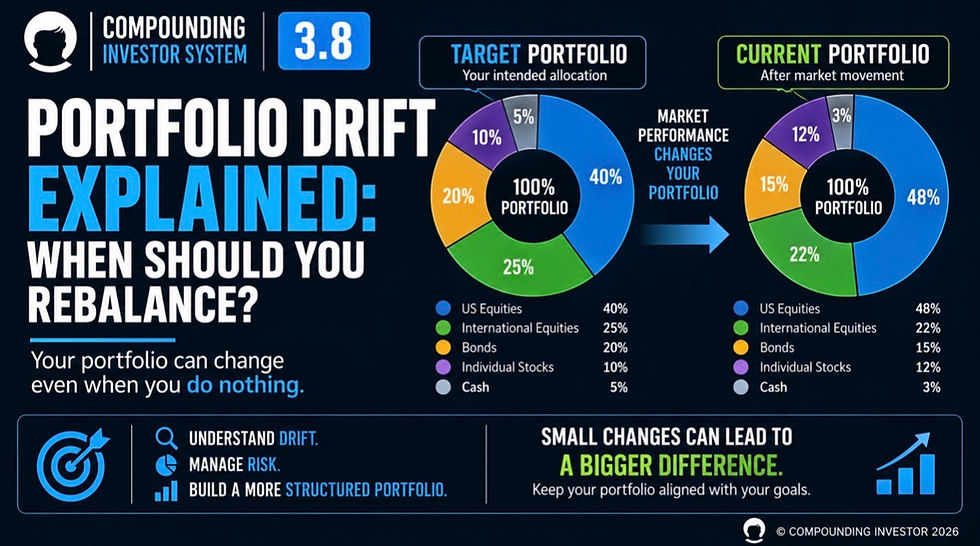
Even if you choose an appropriate stock-bond allocation, it won’t remain there automatically. Markets move. Suppose an investor begins with:
70% Stocks
30% Bonds
Stocks then substantially outperform bonds. Over time, the portfolio might drift towards:
78% Stocks
22% Bonds
Nothing has been deliberately changed. But the portfolio is now more exposed to equity risk than originally intended. This is portfolio drift.
Rebalancing restores the intended allocation. The Investor might:
Alternatively, new contributions, dividends or portfolio withdrawals could be directed towards the underweight asset class.
Rebalancing can also work in the opposite direction. Suppose equities fall sharply and the allocation moves from:
70% Stocks / 30% Bonds
to:
60% Stocks / 40% Bonds
Restoring the original allocation may require:
Sell Some Bonds → Buy Stocks
This creates an important behavioural benefit. Instead of asking:
“Do I think stocks are cheap enough to buy?”
the investor follows a predetermined portfolio rule.
That can systematically direct capital away from assets that have become overweight and towards those that have become underweight.
But rebalancing doesn’t need to mean constantly returning the portfolio to an exact percentage. An investor might instead establish acceptable ranges. For example:
Target Stock Allocation → 70%
Acceptable Range → 65%–75%
Rebalancing occurs only when the allocation moves outside that range. This can reduce unnecessary trading while still controlling portfolio drift. The important distinction is between:
Rebalancing Because the Portfolio Has Drifted
and:
Changing the Target Because Your Circumstances Have Changed
Those are different decisions.
If a 70/30 portfolio drifts to 78/22, rebalancing might restore 70/30. If the investor is approaching retirement and deliberately decides that greater stability is now required, the target itself might change to 60/40.
Structured Compounders understand the difference.
They don’t allow market movements to determine their asset allocation by accident.
And they don’t disguise market predictions as rebalancing decisions. They establish:
Target Allocation → Acceptable Range → Rebalancing Rule → Periodic Review
That turns the stock-bond allocation from a one-time decision into an ongoing portfolio-management process.
Discover What Your Stock-Bond Allocation Reveals About You
Holding bonds doesn’t automatically make an investment portfolio safer. The important question is whether your allocation between stocks and bonds reflects the growth, stability and risk characteristics the portfolio you are trying to build actually requires.
The Free Investor Assessment helps identify:
stock-bond allocation and asset-allocation blind spots
whether your portfolio is taking more or less equity risk than your circumstances require
whether your bond allocation has a clearly defined role within your portfolio
your current Investor Progression Model stage
practical next steps towards becoming a Structured Compounder
Because successful asset allocation isn’t about following a standard 60/40 portfolio or automatically increasing bonds as you get older.
It’s about understanding what role stocks and bonds should each perform, how much risk you genuinely need to take and whether your allocation supports the long-term outcome you are trying to achieve.
Only takes 2-minutes • manually reviewed • delivered within 24 hours
The Academic Whose Bond Allocation Was Actually Increasing His Dependence on the Stock Market
The Investor was a 58-year-old university academic living in Oxford, Ohio.
For more than 30 years, the Investor had contributed consistently to retirement accounts while pursuing an academic career. The portfolio had grown to approximately:
$2.4 Million
The Investor considered the portfolio relatively conservative. Its headline allocation was:
62% Stocks
38% Bonds
That appeared broadly consistent with someone approaching retirement.
The Investor had deliberately increased bonds during the previous decade, gradually moving away from the equity-heavy portfolio held earlier in the academic career. The reasoning seemed sound:
Retirement Approaching → Reduce Equity Exposure → Increase Bonds
There was another important source of financial security. After retirement, the Investor expected to receive a substantial lifetime pension from the university retirement system.
Combined with Social Security, this would cover a significant proportion of normal household expenditure. The Investor therefore appeared unusually well protected.
A substantial pension.
Nearly 40% of the investment portfolio in bonds.
A diversified equity allocation.
And relatively modest expected withdrawals from the investment portfolio.
The Investor’s description was:
“I’ve gradually made the portfolio safer as retirement gets closer.”
But when the complete financial structure was reviewed, the portfolio revealed something much less obvious.
The Investor might actually have been becoming more economically concentrated in bond-like assets, not less risky in the way intended.

What The Review Revealed
The problem became visible when the Investor’s pension was considered alongside the investment portfolio.
The pension wasn’t a bond. It couldn’t simply be bought, sold or rebalanced like one. But economically, it provided something with several bond-like characteristics:
Predictable Lifetime Income
Low Dependence on Equity-Market Performance
Regular Cash Flow
Reduced Need for Portfolio Withdrawals
The Investor had never incorporated that income stream into thinking about overall financial risk. Instead, the retirement portfolio had been analysed in isolation. The logic had been:
I’m Approaching Retirement
↓
Retirement Means Less Risk
↓
Less Risk Means More Bonds
↓
Increase Bond Allocation
But the pension was simultaneously becoming more valuable as retirement approached because the future income stream was getting closer. The Investor was therefore effectively moving in the same direction twice.
First through the increasing economic importance of pension income.
Then again by steadily increasing bonds inside the investment portfolio. The investment account showed:
62% Stocks / 38% Bonds
But that didn’t describe the Investor’s complete financial position. A substantial proportion of future spending was already expected to be funded independently of stock-market performance.
This produced an unexpected consequence.
The Investor had reduced the growth allocation precisely when the need for the portfolio to provide short-term stability had also fallen.
The Real Issue
The problem wasn’t:
Too Many Bonds
Nor was it:
The Investor Was Too Conservative
The real issue was that the Investor had confused:
with:
Household Financial Allocation
The 62/38 portfolio had been constructed as though the investment portfolio were responsible for providing almost all future retirement income. It wasn’t.
The pension fundamentally changed the role the portfolio needed to perform. Consider two investors who each have:
$2.4 Million Investment Portfolio
and both hold:
62% Stocks / 38% Bonds
Investor A has no significant guaranteed retirement income and expects the portfolio to fund most future spending.
Investor B receives sufficient pension and Social Security income to cover most normal expenditure.
The percentages are identical. The economic consequences aren’t.
Investor A may depend heavily on bonds to provide stability and reduce the likelihood of selling equities during a severe market decline.
Investor B may be able to leave much more of the investment portfolio untouched through exactly the same decline.
That meant the Investor’s real question wasn’t:
“I’m 58 — shouldn’t I own more bonds?”
It was:
“How much stability does my investment portfolio need to provide when much of my future spending is already supported elsewhere?”
This exposed a broader portfolio-construction principle. An investor can diversify the investment account while accidentally duplicating the same financial characteristic across their wider wealth. In this case:
Pension → Stable Future Income
Bond Portfolio → Stable Future Income + Capital Stability
The Investor had accumulated substantial protection against one problem:
Insufficient Stability
while potentially increasing exposure to another:
Insufficient Long-Term Growth
The surprising conclusion was that adding more bonds wasn’t necessarily making the Investor’s overall financial position safer. It was changing which risk dominated.
What Changed
The Investor didn’t eliminate bonds. That would have been an equally simplistic response. Instead, the portfolio review started by separating the different jobs future wealth needed to perform.
Income Already Provided Elsewhere
Expected pension and Social Security income were mapped against projected core expenditure. This established how much retirement spending was likely to depend on the investment portfolio.
Portfolio Liquidity
The Investor identified the amount of capital that might realistically be required from the portfolio during the first several years of retirement. That capital needed greater protection from short-term market movements.
Long-Term Capital
The remaining portfolio had a very different job. It wasn’t expected to fund immediate spending.Its investment horizon could potentially extend for decades. The portfolio was therefore reconstructed conceptually as:
External Income → Fund Core Spending
Defensive Portfolio Assets → Support Additional Near-Term Requirements
Equities → Compound Long-Term Capital
Rather than continuing automatically towards an increasingly bond-heavy allocation, the Investor established a deliberate stock-bond target based on those functions. The precise percentages were less important than the change in reasoning. Before:
Getting Older → Retirement Approaching → Increase Bonds
After:
That also changed how the Investor thought about risk. Previously:
More Bonds = Safer
After the review:
Appropriate Assets for Each Financial Requirement = Better Controlled Risk
The Investor could now see why two academics of exactly the same age, retiring from the same university in the same year, might rationally require very different portfolios.
One might depend almost entirely on investment withdrawals.
The other might have substantial guaranteed lifetime income.
Their birthdays wouldn’t determine their asset allocations.
Their financial structures would.
The case therefore produced a counterintuitive conclusion. The Investor had spent years increasing bonds because retirement was approaching.
But the pension meant retirement itself was simultaneously reducing the portfolio’s responsibility for providing immediate income. The appropriate question had never been:
“How Many Bonds Should a 58-Year-Old Own?”
It was:
“What Risks Does My Investment Portfolio Still Need to Solve After the Rest of My Financial Position Is Taken Into Account?”
That is the distinction between selecting an asset allocation from a rule and constructing one from purpose.
The Investor Progression Model: From Choosing Percentages to Allocating Purpose
Stock-bond allocation provides a useful example of how investment decision-making develops. Early-stage investors often focus on the percentage itself. More sophisticated investors focus on why the percentage exists.
Reactive Investor
Allocation decisions are influenced primarily by recent market conditions. After stocks rise:
“I should own more stocks.”
After stocks fall:
“I need more bonds.”
The portfolio’s risk level changes in response to markets rather than the Investor’s financial circumstances.
Lucky Investor
The Investor adopts a familiar rule. Perhaps:
60% Stocks / 40% Bonds
or:
100 − Age = Stock Allocation
The portfolio may be perfectly reasonable. But the Investor can’t clearly explain why that allocation is appropriate for their particular circumstances.
Conservative Compounder
The Investor begins connecting asset allocation to:
Time Horizon + Risk Tolerance + Withdrawal Requirements
Stocks and bonds are no longer selected independently. They are considered parts of an overall portfolio.
Structured Compounder
The Investor goes further. The question changes from:
“What percentage should I hold in stocks and bonds?”
to:
“What does each part of my portfolio need to achieve?”
The Investor considers:
Future Spending
External Income
Investment Horizon
Withdrawal Requirements
Risk Capacity
Risk Tolerance
Required Growth
Required Stability
Only then is the stock-bond allocation determined. The progression becomes:
This is an important shift. The Structured Compounder doesn’t hold 30% bonds because 30% feels conservative.
They hold bonds because a defined proportion of the portfolio needs the characteristics those bonds are intended to provide.
And they don’t hold 80% stocks simply because stocks have greater long-term growth potential.
They hold that allocation because their financial circumstances allow that amount of capital to accept equity-market risk.
The percentage becomes the output of the investment system, rather than the starting point.

Common Stock and Bond Allocation Mistakes
Stock-bond allocation becomes problematic when investors choose percentages without understanding what each asset class is intended to achieve within the portfolio. Common mistakes include:
choosing a stock-bond allocation based entirely on age
assuming bonds are inherently safe
holding bonds without defining what role they are intended to perform
assuming a higher bond allocation automatically means a lower-risk financial position
focusing on risk tolerance while ignoring financial risk capacity
increasing bonds automatically as retirement approaches
reducing stocks because markets feel expensive
increasing stocks because equity markets have recently performed strongly
using the traditional 60/40 portfolio without understanding why 60/40 is appropriate
assuming an all-stock portfolio is automatically unsuitable for older investors
assuming a high equity allocation is appropriate simply because an investor has a long time horizon
treating all bonds as though they have the same risk characteristics
ignoring interest-rate, duration, credit and inflation risk within the bond allocation
looking at the investment portfolio in isolation from pensions and other reliable income
failing to consider how dependent future spending will be on portfolio withdrawals
allowing market movements to change the stock-bond allocation through portfolio drift
rebalancing reactively rather than establishing rules in advance
changing the target allocation because markets have moved rather than because financial circumstances have changed
confusing a strategic change in asset allocation with market timing
focusing on the percentage held in bonds without considering the actual amount of stability or liquidity required
assuming two investors of the same age should have similar stock-bond allocations
building a conservative-looking investment portfolio while ignoring the risk characteristics of the wider financial position
Perhaps the most important mistake is assuming there are only two choices:
Prioritise Growth
or:
Prioritise Safety
There is a more useful question:
What Does Each Asset Class Need to Achieve?
A structured process asks:
What role should stocks perform?
What role should bonds perform?
How much long-term growth does the portfolio require?
How much short-term stability does it require?
When will capital need to be withdrawn?
What income exists outside the portfolio?
How much equity risk can the Investor financially absorb?
What would justify changing the target allocation?
That turns stock-bond allocation from choosing a conventional percentage into capital allocated according to purpose.
Stocks vs Bonds Allocation Comparison
Holding more stocks or more bonds isn’t automatically good or bad portfolio construction. Different stock-bond allocations solve different problems and create different trade-offs.
Higher Stock Allocation | Higher Bond Allocation |
More capital exposed to long-term equity growth | More capital allocated to stability and income |
Greater participation when stock markets rise | Reduced participation when stock markets rise |
Greater exposure to equity-market declines | Can reduce overall portfolio drawdowns |
Higher long-term growth potential | Lower long-term growth potential |
Greater portfolio volatility | Generally lower portfolio volatility |
Greater dependence on equity-market recovery | Less dependence on equity-market recovery |
More capital exposed to business and market risk | More capital exposed to interest-rate, inflation and credit risk |
Less capital available from defensive assets for rebalancing | More capital potentially available for rebalancing after equity declines |
May suit capital with a long investment horizon | May suit capital required sooner |
Greater emphasis on long-term compounding | Greater emphasis on stability and capital preservation |
Requires greater capacity to withstand substantial equity drawdowns | Can reduce the financial and behavioural impact of equity drawdowns |
Asks: “How much equity risk can this capital afford to take?” | Asks: “What benefit justifies allocating this capital away from equities?” |
Neither approach removes risk.
A higher stock allocation increases exposure to:
Equity Drawdowns + Market Volatility + Recovery Risk + Behavioural Risk
A higher bond allocation increases exposure to:
Lower Expected Growth + Inflation + Interest-Rate Risk + Credit Risk
The appropriate structure therefore isn’t necessarily the one with the most stocks or the most bonds.
It is the one where the Investor understands what each asset class is expected to achieve and whether the resulting balance between growth and stability reflects the portfolio’s actual financial requirements.
Quick Stock-Bond Allocation Audit
Ask yourself:
✓ Do I know exactly what percentage of my investment portfolio is currently allocated to stocks and bonds?
✓ Can I explain why I currently hold that particular stock-bond allocation?
✓ Do I understand what role my stock allocation is intended to perform?
✓ Do I understand what role my bond allocation is intended to perform?
✓ Does my allocation reflect my actual investment horizon and withdrawal requirements?
✓ Have I considered my financial risk capacity as well as my tolerance for market volatility?
✓ Have I considered pensions and other reliable income when assessing how much portfolio stability I require?
✓ Do I understand the interest-rate, duration, credit and inflation risks within my bond allocation?
✓ If I hold a traditional allocation such as 60/40, can I explain why that allocation is appropriate for me?
✓ Do I have a rule for rebalancing when stocks or bonds move significantly away from their target allocation?
✓ Would I still choose my current stock-bond allocation if I were constructing the portfolio today?
✓ Do I know what change in my financial circumstances would cause me to increase or reduce my bond allocation?
If several answers are “No”, the issue may not be that you hold too many stocks or too many bonds.
It may be that your stock-bond allocation has developed without becoming part of a deliberate portfolio process.
Who This Guide Is For
This guide is designed for investors who:
✓ Hold both stocks and bonds but aren’t sure whether their current allocation is appropriate
✓ Are considering adding bonds to an equity-heavy portfolio
✓ Want to understand the trade-off between long-term growth and portfolio stability
✓ Are approaching retirement or beginning to make withdrawals from their portfolio
✓ Have traditionally based their stock-bond allocation primarily on age
✓ Are considering whether a traditional 60/40 portfolio is appropriate
✓ Are questioning whether an all-stock portfolio makes sense for their circumstances
✓ Want to understand how pensions, Social Security and other income sources can affect their need for bonds
✓ Want to distinguish between risk tolerance and financial risk capacity
✓ Want clearer rules for rebalancing between stocks and bonds
✓ Want their asset allocation to reflect what their portfolio actually needs to achieve
✓ Are progressing towards becoming a Structured Compounder
This guide is particularly useful for investors who already own a diversified portfolio but want to move beyond choosing conventional percentages towards a more deliberate approach to allocating capital according to purpose.
Who This Guide Is NOT For
This guide is unlikely to be useful if you:
want a universal stock-bond percentage that every investor should follow
want a prediction of whether stocks or bonds will perform better next
want to know exactly when to move from stocks into bonds
assume bonds are automatically risk-free
want short-term trading or market-timing signals
expect a bond allocation to eliminate portfolio losses
want to maximise returns without considering volatility, withdrawals or risk capacity
aren’t prepared to consider pensions, other income and wider financial circumstances when determining portfolio allocation
It is also not an argument that investors should increase their bond allocation. For some investors, a very high equity allocation — or even an all-stock portfolio — may be entirely rational.
The important question is whether the allocation between stocks and bonds reflects a genuine portfolio requirement rather than age-based rules, convention, market predictions or an undefined desire to make the portfolio safer.
Discover What Your Stock-Bond Allocation Reveals About You
Most investors already know roughly how their portfolio is allocated. They can see:
Their stock allocation
Their bond allocation
Their overall asset allocation
Their largest investments
Their total portfolio value
Yet many still cannot answer some of the most important questions about their overall investment process.
Why am I actually holding this percentage in stocks and bonds?
Does my allocation reflect my financial risk capacity or simply my attitude towards volatility?
What role are bonds actually performing within my portfolio?
What stage of the Investor Progression Model am I currently at?
What should I change to become a more structured long-term investor?
Your portfolio may already contain what appears to be a sensible stock-bond allocation. But holding stocks and bonds in conventional percentages isn’t the same as understanding what role each asset class performs within your overall investment strategy.
The Free Investor Assessment helps identify:
hidden weaknesses in your asset-allocation process
your current Investor Progression Model stage
stock-bond allocation, risk-capacity and rebalancing blind spots
opportunities to build a more structured investment system
practical next steps towards becoming a Structured Compounder
Because the best investors don’t simply decide what percentage they want to hold in stocks and bonds. They understand why each asset class exists, what purpose it serves and what would justify changing the allocation.
And once those decisions are deliberate, you can make far better decisions about portfolio risk, diversification, rebalancing, withdrawals, asset allocation and long-term compounding.
Takes Less Than 2-Minutes
FAQ
What is a good stock-bond allocation?
There is no universal percentage. The appropriate allocation depends on factors including investment horizon, withdrawal requirements, external income, risk capacity, risk tolerance and what the portfolio needs to achieve.
Is a 60/40 stock-bond portfolio still a good strategy?
It can be. A 60/40 portfolio combines substantial exposure to long-term equity growth with a meaningful bond allocation for stability and diversification. But 60/40 should be treated as a possible portfolio structure rather than a default allocation for every investor.
Should I increase my bond allocation as I get older?
Not automatically. Age can be useful context, but investment horizon, portfolio withdrawals, pension income, other assets and financial risk capacity are more important than age alone.
Is a 100% stock portfolio too risky?
Not necessarily. An all-stock portfolio may be rational for an investor with a long investment horizon, high risk capacity, limited near-term withdrawal requirements and the ability to remain invested through substantial market declines.
Are bonds safer than stocks?
Bonds generally have different and often less volatile risk characteristics than stocks, particularly high-quality shorter-duration bonds. But bonds aren’t risk-free and can be affected by interest rates, inflation, duration and credit risk.
Why hold bonds if stocks have higher long-term growth potential?
Because maximising expected return isn’t the only objective of portfolio construction. Bonds can provide income, greater stability, diversification, withdrawal support and capital that may be available for rebalancing during equity-market declines.
Can stocks and bonds fall at the same time?
Yes. Stocks and bonds are driven by different factors, but that doesn’t mean they will always move in opposite directions. A bond allocation can improve diversification without guaranteeing protection whenever stocks fall.
What is the difference between risk tolerance and risk capacity?
Risk tolerance describes how much volatility an investor is emotionally willing to accept.
Risk capacity describes how much investment loss the investor’s financial circumstances can actually absorb.
A sound stock-bond allocation needs to consider both.
How often should I rebalance between stocks and bonds?
There is no universal schedule. Investors may rebalance periodically, when allocations move outside predetermined ranges, or use new contributions and withdrawals to restore the target allocation. The important point is to establish the process before market movements create pressure to make an emotional decision.
Should pension income affect my stock-bond allocation?
Potentially, yes. Reliable pension income can reduce dependence on portfolio withdrawals and therefore change the amount of stability the investment portfolio itself needs to provide. The appropriate allocation should reflect the investor’s overall financial position, not simply their age or investment-account balance.
Explore The Full Framework
The Investor Progression Model White Paper |
This guide forms part of the Compounding Investor Progression Model—a framework designed to help investors move from reactive decision-making towards a repeatable, structured investment process. Inside the white paper you’ll discover: ✓ The four investor types ✓ Why most investors plateau ✓ The five dimensions of investor progression ✓ How Structured Compounders build repeatable systems ✓ The research behind the Investor Assessment |
⬇ READ THE WHITE PAPER ⬇ |
Related Articles
Continue Building Your Portfolio Management System
Build the target → actual → variance framework for understanding where portfolio capital is allocated.
Examine how individual position size determines the influence one company can have over portfolio outcomes.
Explore how the number of holdings affects diversification, concentration and portfolio structure.
Understand how sector exposure can influence portfolio diversification and risk.
Identify where your portfolio is geographically exposed and whether that exposure reflects your intended allocation.
Explore how portfolio weighting determines how much influence individual investments have over overall outcomes.
Compare systematic diversification through ETFs with the control and research requirements of owning individual stocks.
Understand how cash, liquidity and opportunity capital interact with your wider asset-allocation strategy.
Final Thought
The stock-bond decision is often reduced to a percentage.
80/20
70/30
60/40
But the percentage itself tells you very little about whether a portfolio is well constructed. Two investors can hold exactly the same stock-bond allocation while having completely different:
Investment Horizons + Withdrawal Requirements + Income Sources + Risk Capacity + Portfolio Objectives
The better question is therefore not:
“What percentage should I hold in stocks and bonds?”
It is:
“What does each asset class need to achieve within my portfolio?”
Stocks can provide long-term growth.
Bonds can provide stability, income, diversification and rebalancing capacity.
But neither allocation should exist simply because an age-based rule, conventional portfolio model or market outlook suggests that it should. The strongest portfolios connect allocation to purpose.
Understand Your Financial Position → Define What the Portfolio Must Achieve → Allocate Stocks and Bonds Deliberately → Rebalance to Maintain the Structure
Because successful asset allocation isn’t about finding the perfect stock-bond percentage.
It is about building a portfolio where the amount of risk you take reflects the amount of risk you actually need and can afford to take.


Comments