3.13 – How Much Cash Should You Hold in Your Investment Portfolio?
Updated: 7 days ago
Holding Cash Can Reduce Risk — But It Can Also Reduce Compounding
Imagine two investors each have a $1 million investment portfolio. The first holds:
$950,000 Invested
$50,000 Cash
The second holds:
$800,000 Invested
$200,000 Cash
Both investors might describe themselves as long-term investors.
Both might own broadly similar investments.
But their portfolios will behave very differently. The second investor has:
less capital exposed when markets fall
more liquidity available when opportunities appear
greater ability to meet withdrawals without selling investments
but also less capital participating when markets rise
This creates an important portfolio-construction question:
How Much Cash Should You Hold in Your Investment Portfolio?
The obvious answer might appear to be:
Enough to Make the Portfolio Safer
But that immediately creates another question:
Safer From What?
Cash can protect an investor from several different problems.
It can provide liquidity for planned withdrawals.
It can reduce the likelihood of having to sell investments during a market decline.
It can provide capital for future opportunities.
And it can reduce short-term portfolio volatility.
But cash creates its own risk. Money held in cash is money that isn’t fully participating in the long-term returns generated by productive assets.
If markets compound strongly while a substantial cash allocation remains unused, the apparent safety of cash can create a different cost:
Cash Drag
That doesn’t mean holding cash is wrong.
It means cash should have a purpose.
An investor holding 15% cash because they expect to withdraw it over the next two years is making a fundamentally different decision from an investor holding 15% because they believe the stock market is about to fall.
The percentage is identical.
The investment process is not.
And a third investor might hold exactly the same 15% because dividends, investment sales or other proceeds have simply accumulated. That is different again:
Deliberate Cash → Defined Portfolio Role
Strategic Cash → Waiting for Opportunity
Accidental Cash → Capital Without a Decision
The appropriate cash allocation therefore cannot be determined by one universal percentage. It depends on factors including:
Investment Horizon + Liquidity Needs + Withdrawal Plans + Income Sources + Risk Capacity + Portfolio Structure
The real question isn’t simply:
“How much cash should I hold?”
It is:
“Why am I holding this cash — and what would cause me to use or invest it?”
In this guide, we’ll examine how much cash investors might hold, the difference between emergency cash and portfolio cash, how cash changes portfolio risk and expected returns, when liquidity becomes cash drag, whether investors should hold cash waiting for market opportunities, how retirement changes the calculation and how Structured Compounders give cash a defined role rather than allowing it to accumulate without purpose.

Who This Guide Is For
This guide is designed for long-term investors who want to think more deliberately about the role cash should play within their investment portfolio. It will be particularly valuable if you:
hold a meaningful percentage of your investment portfolio in cash
regularly accumulate dividends or sale proceeds before reinvesting them
keep cash available to invest during market declines
are unsure whether cash should form part of your asset allocation
worry that being fully invested leaves you without enough flexibility
are concerned that too much cash is reducing long-term returns
are approaching retirement or beginning portfolio withdrawals
want to distinguish emergency savings from investment-portfolio cash
have recently sold a business, property or other substantial asset
are waiting for a “better time” to invest a significant amount of capital
want clearer rules for deciding when cash should be held or deployed
are progressing towards becoming a Structured Compounder
The central question changes as investors become more sophisticated.
An early-stage investor may ask:
“Should I keep some money in cash?”
A developing investor asks:
“What percentage of my portfolio should be cash?”
A more structured investor asks:
“What purpose is my cash allocation serving?”
A Structured Compounder goes further:
“What specific risk or future requirement does this cash protect me against — and what rule determines when it should be deployed?”
That is the progression this guide explores.
What You'll Learn | |
Portfolio Cash vs Emergency Cash | Why cash held for personal emergencies should be distinguished from cash deliberately maintained inside an investment portfolio. |
How Much Cash Should You Hold? | Why there is no universal ideal percentage and how investment horizon, withdrawals and portfolio structure affect the decision. |
Cash & Portfolio Risk | How cash can reduce volatility and forced-selling risk while introducing different long-term risks. |
The Cost of Cash Drag | How holding substantial cash for long periods can reduce the amount of capital benefiting from investment compounding. |
Cash for Market Opportunities | Why keeping “dry powder” can provide flexibility — and when it quietly becomes a market-timing strategy. |
Cash in Retirement | How withdrawals and sequence-of-returns risk can make liquidity more valuable once a portfolio begins funding expenditure. |
The Investor Progression Model | How investors progress from simply accumulating cash towards defining its purpose and deployment rules. |
Contents
What Counts as Cash in an Investment Portfolio?
Portfolio Cash vs Emergency Cash
How Much Cash Should You Hold in Your Investment Portfolio?
What Determines the Right Cash Allocation?
How Cash Changes Portfolio Risk
The Hidden Cost of Holding Too Much Cash
Should You Hold Cash Waiting for a Market Crash?
Cash as Dry Powder: Optionality or Market Timing?
Should Dividends and Sale Proceeds Stay in Cash?
How Much Cash Should Retired Investors Hold?
Cash and Sequence-of-Returns Risk
When a Large Cash Position May Be Rational
Real Investor Case Study — Manchester, England 🇬🇧
What the Review Revealed
The Real Issue
What Changed
The Investor Progression Model: From Idle Cash to Deliberate Liquidity
Common Cash Allocation Mistakes
Cash Allocation Strategy Comparison
Quick Portfolio Cash Audit
Who This Guide Is For
Who This Guide Is Not For
FAQ
Explore The Full Framework
Related Articles
Final Thought
What Counts as Cash in an Investment Portfolio?
Cash sounds like the simplest asset in a portfolio. But investors often mean different things when they say:
“I hold 10% in cash.”
That could include:
cash sitting in a brokerage account
money-market funds
short-term cash deposits
proceeds from recently sold investments
accumulated dividends
cash deliberately reserved for future investments
money being held for near-term portfolio withdrawals
These balances may all appear cash-like. But they don’t necessarily perform the same role. The important distinction is between:
Cash as a Temporary Balance
and:
Suppose an investor sells a $30,000 position on Monday and reinvests the proceeds on Friday. Technically, the portfolio held additional cash for several days. But that doesn’t mean the investor has adopted a strategic cash allocation. Now imagine another investor deliberately maintains:
10% Cash
with a policy that this liquidity should remain available throughout different market conditions. That is a genuine portfolio allocation decision. A third investor may have accumulated:
$75,000 Cash
through dividends, investment sales and new contributions without ever deciding how much cash the portfolio should contain. That is neither clearly temporary nor deliberately strategic. It is simply:
This distinction matters because the percentage alone tells us very little.
Two investors can each hold 10% cash while one is deliberately managing liquidity and the other is simply delaying an investment decision. A Structured Compounder therefore asks:
Why Is This Money in Cash?
How Long Is It Expected to Remain There?
What Specific Purpose Does It Serve?
What Would Cause It to Be Invested or Spent?

Portfolio Cash vs Emergency Cash
One of the most important distinctions is between:
Emergency Cash
and:
Portfolio Cash
They may be held in similar places. But they solve different problems.
Emergency Cash
Emergency cash exists primarily to protect the investor’s personal finances.
It might be needed for:
unexpected household expenditure
temporary loss of income
major repairs
medical or family costs
other unforeseen short-term requirements
Its job isn’t to improve investment returns. Its job is to prevent an unexpected financial event from forcing the investor to disrupt the investment portfolio.
Portfolio Cash
Portfolio cash exists inside the investment strategy. It might be held to:
fund planned withdrawals
provide liquidity during retirement
receive dividends before reinvestment
accommodate investment sales
provide capital for deliberately identified opportunities
The distinction can be represented as:
Emergency Cash → Protects Household Liquidity
This matters when calculating allocation. Suppose an investor has:
$500,000 Investment Portfolio
and:
$30,000 Emergency Fund
If that $30,000 exists outside the investment strategy to cover household emergencies, treating the portfolio as:
94.3% Investments / 5.7% Cash
may misrepresent the investor’s actual investment allocation. The investment portfolio may effectively be fully invested.
]Conversely, if the investor deliberately keeps $30,000 inside the $500,000 portfolio to fund future withdrawals, that cash is part of the portfolio structure.
The same amount of money.
A completely different purpose.
Before asking:
“How much cash should my portfolio hold?”
therefore separate:
Cash Needed Outside the Portfolio
from:
Otherwise two fundamentally different financial decisions become mixed together.
How Much Cash Should You Hold in Your Investment Portfolio?
There is no single percentage that every investor should hold in cash. For one investor:
0–5%
might provide all the portfolio liquidity required. Another may deliberately hold:
10–15%
A retired investor funding substantial near-term withdrawals may rationally hold more.
The appropriate percentage depends less on a universal rule than on what the cash needs to accomplish. A useful starting point is:
Rather than:
Percentage → Justification Afterwards
Consider three investors.
Investor A — Long Investment Horizon
The Investor has:
stable employment income
a separate emergency fund
no planned portfolio withdrawals
a long investment horizon
There may be relatively little reason to maintain a large permanent portfolio cash allocation.
Investor B — Approaching Retirement
The Investor expects the portfolio to begin funding expenditure within the next few years. Liquidity becomes more important because the portfolio may soon need to provide:
Investment Assets → Cash → Spending
Investor C — Waiting for Opportunities
The Investor has no withdrawal requirement but holds 20% cash because:
“I want to buy when the market falls.”
That may be a legitimate strategy. But it is fundamentally different from Investors A and B. The cash isn’t protecting a known liquidity requirement. It represents a decision that future investment opportunities may be more attractive than current ones.
The investor should therefore recognise that part of the portfolio is effectively making a judgement about when capital should enter the market. This is why asking:
“Should I hold 5%, 10% or 20% cash?”
starts in the wrong place. Start instead with:
Then determine how much capital that requirement actually justifies.
What Determines the Right Cash Allocation?
The appropriate cash allocation depends on several interacting factors.
Investment Horizon
An investor with decades before the portfolio is needed can usually tolerate more short-term market volatility than someone expecting to draw from it soon. The longer the investment horizon, the greater the potential cost of leaving substantial capital outside productive assets without a defined reason.
Withdrawal Requirements
If the portfolio needs to fund regular spending, cash has a practical function.
The question becomes:
How Much Spending Should Be Protected From Short-Term Market Movements?
This is very different from holding cash because markets appear expensive.
Income Outside the Portfolio
Two investors with identical portfolios may require very different liquidity. One may have substantial employment, pension, rental or business income. Another may depend almost entirely on portfolio withdrawals. Their appropriate cash allocations need not be the same.
Risk Capacity
Cash can reduce the immediate effect of falling asset prices on total portfolio value.
That may matter particularly when the investor has limited ability to recover from a major drawdown. But risk capacity should be distinguished from:
Risk Anxiety
Holding excessive cash because normal market volatility feels uncomfortable may indicate that the wider asset allocation needs reviewing.
Portfolio Structure
A portfolio already containing substantial defensive or lower-volatility assets may require a different cash allocation from an aggressive equity portfolio. Cash shouldn’t be assessed in isolation from:
Stocks + Bonds + Other Assets + Cash
Future Capital Requirements
Known future expenditure can justify holding capital outside volatile assets. If money is likely to be required relatively soon, maximising long-term expected return may not be its primary objective.
These factors create a more useful framework:
Time Horizon + Withdrawals + External Income + Risk Capacity + Portfolio Structure + Known Capital Needs
↓
Liquidity Requirement
↓
Cash Allocation
How Cash Changes Portfolio Risk
Cash reduces some forms of portfolio risk. But it doesn’t eliminate risk. Imagine a portfolio containing:
100% Equities
If the equity market falls 30%, the portfolio is fully exposed to that decline. Now imagine:
80% Equities
20% Cash
If the equity component falls 30% and the cash value remains unchanged, the simplified portfolio decline would be approximately:
24%
Cash has reduced the immediate drawdown. It can also reduce:
short-term portfolio volatility
dependence on selling investments during declines
liquidity pressure
exposure to individual market events
That can be extremely valuable. But the investor has exchanged one set of risks for another. Cash introduces or increases exposure to:
inflation eroding purchasing power
lower long-term expected returns
reinvestment decisions
opportunity cost when markets rise
behavioural market timing
This creates an important distinction:
versus:
Cash can reduce the first while increasing the second. The effect also depends on why the cash exists.
If it prevents a retired investor from selling equities during a severe market decline, its value may extend far beyond the interest it earns.
If it sits unused for ten years because the investor is continually waiting for a better entry point, the same cash may have materially weakened long-term compounding.
So cash shouldn’t simply be described as:
Low Risk
It is better understood as an asset that changes the types of risk the portfolio carries.
The Hidden Cost of Holding Too Much Cash
Cash feels inexpensive because its cost doesn’t normally appear as a visible loss. If:
$100,000 Cash
still shows approximately:
$100,000
on the account statement, nothing appears to have gone wrong. But investment opportunity cost works differently. Suppose an investor has a:
$1 million Portfolio
and deliberately holds:
20% Cash = $200,000
If the remaining $800,000 compounds at 8% while the cash earns 3%, after one year:
Invested Assets → $864,000
Cash → $206,000
Total → $1,070,000
Now compare that with the simplified outcome if the entire $1 million had earned 8%:
$1,080,000
The difference in the first year is:
$10,000
That may not appear significant relative to a $1 million portfolio. But repeated over long periods, differences in compounding accumulate. This is the hidden cost commonly described as:
The problem isn’t that cash earns nothing. Cash may earn meaningful interest.
The problem is that over long periods it may earn less than the productive assets the investor deliberately chose not to own. And unlike a market decline, cash drag may never produce an alarming red number on a portfolio statement. Instead, the cost appears as:
Wealth That Was Never Created
This makes excessive cash psychologically unusual. A 20% market decline is immediately visible. Years of underinvestment are much harder to see. But the solution isn’t:
Always Minimise Cash
Cash may be performing a valuable function that justifies its opportunity cost. The better question is:
“What am I receiving in exchange for accepting this cash drag?”
If the answer is:
Liquidity
Withdrawal Protection
Reduced Forced-Selling Risk
A Defined Strategic Reserve
then the cost may be entirely rational. If the answer is simply:
“I haven’t decided when to invest it yet.”
then what appears to be portfolio safety may actually be an unresolved investment decision accumulating a compounding cost.
Should You Hold Cash Waiting for a Market Crash?
Holding cash for a market decline sounds intuitively attractive. The strategy appears simple:
Hold Cash When Markets Are Expensive
↓
Wait for Prices to Fall
↓
Invest at Lower Prices
If markets subsequently fall 20%, 30% or 40%, the investor with available cash has something the fully invested investor doesn’t:
Capital Available to Deploy
The difficulty is that this strategy requires more than correctly predicting that markets will eventually decline.
Market declines are inevitable.
Their timing isn’t.
An investor holding cash must effectively make two decisions:
and later:
When to Invest
Consider an investor who moves:
$100,000
into cash because markets appear expensive. Over the following two years, the market rises:
25%
before eventually declining:
15%
The investor correctly anticipated that a market decline would eventually occur. But the market after the decline may still be above the level at which the investor originally decided to wait.
There is another behavioural problem.
Investors often imagine deploying cash confidently when markets fall. But a 30% decline rarely arrives accompanied by reassuring news. It may arrive alongside:
recession
falling corporate earnings
financial instability
geopolitical uncertainty
unemployment
pessimistic market forecasts
The investor who found markets too risky before the decline may find them even harder to buy afterwards.
Cash held for a crash therefore needs more than an intention. It needs a deployment rule. Without one:
Waiting for Lower Prices
can gradually become:
And markets rarely offer low prices and high certainty at the same time.
Cash as Dry Powder: Optionality or Market Timing?
Investors often describe portfolio cash as:
Dry Powder
The phrase captures a genuine advantage. Cash provides optionality.
It allows the investor to act without first selling another investment. That can be useful when:
an attractive investment becomes available
market prices fall substantially
an existing holding becomes unusually attractive
portfolio rebalancing creates a need for capital
circumstances change unexpectedly
Optionality has value. But there is an important difference between:
Having Cash Available
and:
Holding Cash Because You Expect Better Prices
The first is primarily a liquidity decision.
The second contains an element of market timing.
Imagine an investor establishes:
5% Strategic Cash Reserve
with clearly defined circumstances under which that capital can be deployed. That is different from allowing cash to rise to:
25%
because:
“The market feels expensive.”
The first has:
The second depends increasingly on predicting future market conditions.
There is nothing inherently irrational about making a valuation judgement. But the investor should recognise the decision being made.
Cash isn’t neutral.
Every dollar deliberately held outside the market represents a decision that retaining optionality is currently more valuable than investing that capital. A Structured Compounder therefore asks:
How Much Optionality Do I Actually Need?
What Is It For?
What Is the Maximum Cash Allocation I Will Allow?
What Happens If Those Conditions Never Arrive?
That turns “dry powder” from a vague intention into a portfolio policy.
Should Dividends and Sale Proceeds Stay in Cash?
Cash often develops without the investor deliberately creating it.
Dividends arrive.
A company is sold.
An ETF is reduced.
A bond matures.
New contributions enter the account.
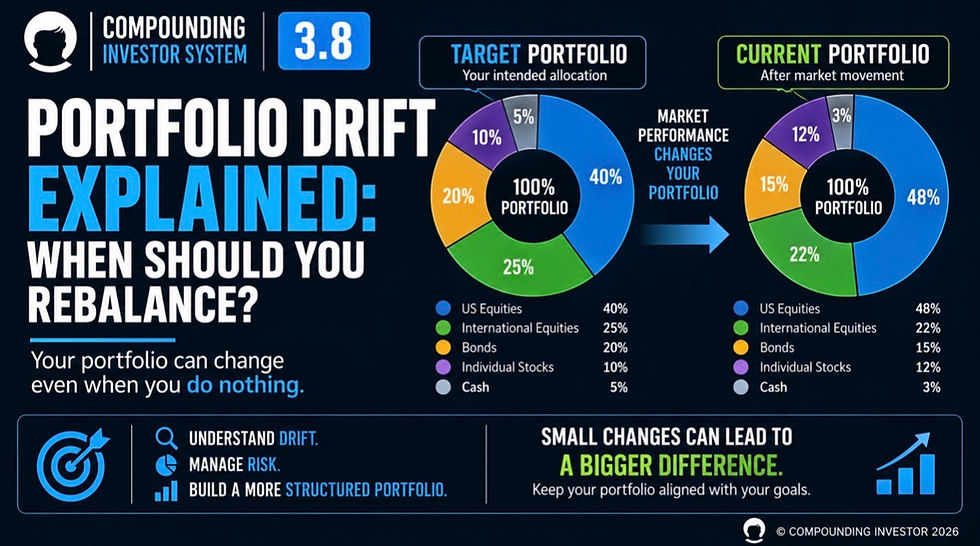
Over time:
2% Cash → 4% → 7% → 10%
without the investor ever deciding:
“I want 10% of my portfolio in cash.”
This is one of the easiest ways for portfolio allocation to drift. Whether dividends and sale proceeds should remain in cash depends on why they haven’t yet been reinvested. A short delay may be entirely practical. The investor may be:
reviewing portfolio allocation
waiting to combine several small cash flows
funding a planned withdrawal
preparing to rebalance
evaluating where capital is most needed
But temporary cash can quietly become permanent. This is particularly important with dividends. An investor may think:
But if they accumulate as cash for months before deployment, part of the portfolio is continually sitting outside the intended allocation.
Sale proceeds create another question. If an investor sells a:
$50,000 Position
the relevant decision isn’t complete when the stock is sold. There are now two decisions:
Why Did I Sell?
and:
What Should the $50,000 Do Next?
Without an answer to the second question, selling an investment creates an unintended cash allocation. A structured process therefore gives cash flows a default destination. For example:
Sale Proceeds → Reallocate / Strategic Cash / Planned Withdrawal
The objective isn’t to reinvest every dollar immediately. It is to prevent temporary cash from becoming permanent simply through inertia.
How Much Cash Should Retired Investors Hold?
Retirement changes the role of cash. Before retirement, an investor may regularly add capital to the portfolio. After retirement, the direction can reverse:
That makes liquidity more important. Imagine a retired investor requires:
$60,000 per year
from a portfolio. If the investor holds almost no cash and equity markets fall sharply, withdrawals may require selling investments after substantial declines. A deliberate cash reserve can provide an alternative source of spending. For example:
$120,000 Cash
could represent approximately:
Two Years of Planned $60,000 Withdrawals
That doesn’t mean every retired investor should hold two years of spending in cash. There is no universal rule. The appropriate amount depends on factors such as:
spending requirements
pension and other guaranteed income
portfolio size
asset allocation
flexibility of expenditure
withdrawal rate
other liquid assets
risk capacity
An investor receiving substantial pension income may need relatively little portfolio cash.
Another investor whose living costs depend almost entirely on portfolio withdrawals may value a larger liquidity reserve.
The relevant measure therefore isn’t simply:
Cash as % of Portfolio
It can also be:
That reframes the question. Instead of asking:
“Should a retired investor hold 10% cash?”
ask:
“How much spending do I want to protect from having to sell volatile assets at an unfavourable time?”
Cash in retirement therefore has a much clearer potential function:
Its purpose isn’t necessarily to predict markets. It is to reduce the dependence of near-term spending on what markets happen to be doing.
Cash and Sequence-of-Returns Risk
For an investor who isn’t withdrawing from the portfolio, the order in which investment returns occur may matter less than the overall long-term return. Once withdrawals begin, the sequence becomes much more important.
Consider two retired investors with identical starting portfolios.
Both ultimately experience the same long-term average return.
But:
Investor A
experiences strong returns early in retirement and weaker returns later.
Investor B
experiences a severe market decline immediately after retirement and stronger returns later.
The outcomes can still be very different.
Why?
Because Investor B is withdrawing money while asset prices are depressed. Those withdrawals may require more units or shares to be sold. That capital is then no longer present when markets recover. This is:
Cash can help manage this problem. A retirement portfolio might conceptually separate:
Near-Term Spending → Cash
Medium-Term Stability → Defensive Assets
Long-Term Growth → Growth Assets
During a major equity decline, near-term expenditure can potentially be funded from cash rather than immediately selling depressed growth assets. But cash doesn’t eliminate sequence risk.
And holding excessive cash introduces the long-term compounding costs discussed earlier. The objective is therefore not:
Hold Enough Cash to Avoid Every Market Decline
It is:
Hold Enough Liquidity That Near-Term Spending Doesn’t Depend entirely on Short-Term Market Conditions
That is a fundamentally different purpose from keeping cash available because the investor expects markets to fall. One is primarily:
Withdrawal Risk Management
The other is:
Market Timing
The cash may look identical on a portfolio statement. Its role is completely different.
When a Large Cash Position May Be Rational
A large cash allocation is often treated as evidence that an investor is overly cautious.
Sometimes it is. But percentage size alone doesn’t tell us whether the allocation is rational. There are circumstances where a substantial cash position can have a clear purpose.
A Major Liquidity Event
An entrepreneur who has recently sold a business might suddenly receive several million dollars. Moving immediately from:
Concentrated Private Business
to:
Fully Invested Public-Market Portfolio
isn’t necessarily required. A temporary cash allocation may provide time to construct the new portfolio deliberately.
Known Near-Term Expenditure
If substantial capital will be required relatively soon, exposing that money to volatile assets may create unnecessary risk.
Retirement Withdrawals
An investor dependent on the portfolio for spending may deliberately maintain a larger liquidity reserve.
A major change in investment strategy may temporarily produce higher cash while capital is being reallocated.
Unusually Limited Risk Capacity
An investor may have circumstances where a severe portfolio drawdown would create consequences that cannot easily be recovered from. Cash may form part of managing that risk. But each justification has something in common:
A large cash position becomes more difficult to justify when the explanation is simply:
“I’m waiting.”
Waiting for:
a correction
a recession
interest rates to change
valuations to improve
the political situation to settle
markets to become clearer
can leave capital permanently dependent on an event whose timing and consequences are unknowable. This gives us a useful distinction:
can be entirely rational. Whereas:
Large Cash Position + Indefinite Waiting + No Deployment Rule
is effectively an ongoing allocation decision without a clear investment process. The question is therefore not:
“Is 20% cash too much?”
It is:
“Why is 20% cash appropriate for this investor, for this purpose, at this point in time?”
If that question has a clear answer, a large cash position may be completely deliberate.
If it doesn’t, the cash itself may not be the real problem.
The absence of a decision may be.
Discover What Your Cash Allocation Reveals About You
Holding cash doesn’t automatically make an investment portfolio safer. The important question is whether each dollar held in cash has a clear purpose within the portfolio you are trying to build.
The Free Investor Assessment helps identify:
cash-allocation and liquidity blind spots
whether idle cash is creating unnecessary drag on long-term compounding
whether cash held for future opportunities has become unintended market timing
your current Investor Progression Model stage
practical next steps towards becoming a Structured Compounder
Because successful cash allocation isn’t about remaining fully invested at all times or keeping large amounts permanently available for the next market decline.
It’s about understanding why you are holding cash, what role it performs and what would cause you to deploy it.
Only takes 2-minutes • manually reviewed • delivered within 24 hours
The Entrepreneur Who Had Learned That Cash Creates Opportunity
The Investor was a 52-year-old e-commerce entrepreneur from Manchester, England.
Over more than 20 years, the Investor had built and sold several businesses.
Those exits had created substantial personal wealth, but they had also shaped how the Investor thought about capital. Throughout the Investor’s entrepreneurial career, cash had been valuable.
Cash allowed the Investor to:
acquire inventory when competitors were constrained
launch new businesses quickly
negotiate from a position of strength
acquire smaller competitors
survive periods of weak trading
invest aggressively when attractive opportunities appeared
The lesson had been reinforced repeatedly:
Cash = Optionality
Following the most recent business exit, approximately $3.2 million was available for long-term investment.
The Investor gradually built a diversified portfolio of equities and ETFs. But three years later, approximately:
$1.9 Million → Invested
$1.3 Million → Cash
More than 40% of the investable portfolio remained in cash. The Investor didn’t consider this particularly conservative. The explanation was:
“I like having capital available when something exceptional appears.”
Given the Investor’s business history, that reasoning made intuitive sense. The interesting question was whether a principle that had worked exceptionally well in entrepreneurship was equally effective inside a long-term investment portfolio.

What The Review Revealed
The review initially focused on what the $1.3 million cash position was actually for. The Investor gave several answers:
Market Opportunities
Some cash was available if equity markets fell substantially.
Individual Investments
The Investor wanted capital available if an unusually attractive company appeared.
Another Business
There was always the possibility of acquiring or backing another e-commerce business.
Security
After years of operating leveraged businesses, substantial liquidity felt valuable.
Each explanation was individually reasonable. The problem emerged when the cash was divided according to those purposes. There was no defined amount allocated to any of them.
The same $1.3 million was psychologically performing several jobs simultaneously. It was:
Investment Dry Powder
and:
Potential Acquisition Capital
and:
Financial Security
and:
Market-Crash Capital
The Investor therefore perceived considerably more optionality than the portfolio actually contained.
If $750,000 were eventually used to acquire another business, it couldn’t also be deployed into equities during a market decline. The review revealed another pattern.
During the previous three years, markets had already experienced several periods of volatility. Yet very little of the cash had been invested. When markets were rising:
“Prices are too high.”
When markets fell:
“There may be a better opportunity if they fall further.”
The Investor wasn’t failing to identify opportunities. The Investor had never defined what qualified as an opportunity sufficient to release the cash.
The Real Issue
The problem wasn’t simply that the Investor held too much cash. It was that business optionality and portfolio optionality had been treated as though they were the same thing.
During the Investor’s entrepreneurial career, cash had provided genuine strategic advantages.
A competitor might suddenly become available for acquisition.
A supplier might offer unusually favourable inventory terms.
A new sales channel might require rapid investment.
And critically, the Investor often had substantial influence over what happened after the capital was deployed. Public markets were different.
The Investor couldn’t create the opportunity. The Investor could only decide whether the current market price was attractive enough to participate.
That changed the economics of permanently maintaining a large reserve. The Investor had transferred a highly successful business principle:
Never Run Out of Ammunition
into an investment portfolio where the same principle had gradually become:
Never Fully Deploy the Ammunition
There was also no point at which the cash strategy could be judged unsuccessful.
If markets rose:
Wait
If markets fell 10%:
Wait for 20%
If markets fell 20%:
Conditions are deteriorating — wait
If markets recovered:
The opportunity has gone — wait for the next one
The strategy had no failure condition. That was the real issue. Not:
40% Cash
but:
40% Cash With No Defined Job, Limit or Deployment Rule
What Changed
The Investor didn’t immediately invest the entire $1.3 million. That would simply have replaced one arbitrary decision with another. Instead, the cash was separated according to purpose.
Business Opportunity Capital
A defined amount was ring-fenced outside the long-term investment portfolio.
This capital existed because the Investor genuinely wanted the ability to participate in another private business opportunity. It was no longer treated as portfolio cash.
Personal Liquidity
A separate reserve was established for financial security and foreseeable personal requirements. Again, this wasn’t treated as investment capital waiting for a market opportunity.
Strategic Portfolio Cash
Only the remaining cash was classified as part of the investment portfolio. And that cash required explicit deployment rules. The Investor could no longer justify holding it indefinitely with:
“I’ll invest when opportunities improve.”
Instead, capital would be deployed according to a predetermined process, with part invested systematically and a smaller strategic reserve retained for genuinely unusual opportunities.
The conceptual change was more important than the precise percentages. Before:
$1.3M Cash → Multiple Possible Purposes → No Deployment Rule
After:
Business Capital → Defined Purpose
Personal Liquidity → Defined Purpose
The Investor still held more liquidity than many long-term investors would choose. That wasn’t necessarily a problem. The Investor had legitimate reasons for doing so.
What disappeared was ambiguous cash.
The review therefore didn’t teach an experienced entrepreneur that holding cash was wrong. It identified something more subtle. A principle that had contributed to several successful business exits had been transferred into a different capital-allocation environment without being redesigned for it.
In business, preserving cash had repeatedly created opportunities. In the investment portfolio, preserving cash indefinitely had started to become the strategy itself. The lesson was:
Cash creates optionality only if you know what you are preserving the option to do.
The Investor Progression Model: From Idle Cash to Deliberate Liquidity
The Investor Progression Model helps explain how the role of cash develops as an investor becomes more structured.
An early-stage investor often allows cash to accumulate:
“I haven’t decided what to invest it in yet.”
The next stage starts thinking about opportunity:
“I want some cash available if markets fall.”
A more structured investor asks:
“How much cash does my portfolio actually need?”
The Structured Compounder goes one level further:
“What specific purpose does each cash allocation serve — and what rule determines when it should be deployed?”
The progression becomes:
This changes how cash is interpreted. A 15% cash allocation isn’t simply:
15% Not Invested
It represents capital that should be performing a specific function. That might be:
Liquidity
Near-Term Withdrawals
Rebalancing Capacity
Strategic Optionality
Known Future Expenditure
The Structured Compounder therefore stops viewing cash as whatever remains after investment decisions have been made. Cash becomes an allocation decision in its own right. That means asking:
Why am I holding this cash?
How much does that purpose actually require?
Is this portfolio cash or money required elsewhere?
What would cause me to deploy it?
What is the maximum cash allocation I am prepared to hold?
What happens if the opportunity I am waiting for never arrives?
How much compounding am I potentially sacrificing for this liquidity?
Has temporary cash quietly become a permanent allocation?
The objective isn’t to minimise cash.
It is to ensure that every meaningful cash balance exists because of a deliberate decision rather than inertia, fear or an indefinitely postponed investment decision.

Common Cash Allocation Mistakes
Cash allocation becomes problematic when investors either treat cash as inherently safe or fail to recognise that holding it is itself an investment decision. Common mistakes include:
mixing emergency savings with investment-portfolio cash
allowing dividends and sale proceeds to accumulate indefinitely
holding cash without defining what it is for
assuming more cash always means less portfolio risk
ignoring inflation and long-term opportunity cost
waiting for a market crash without establishing deployment rules
continually moving the required entry price lower as markets decline
describing indefinite market timing as keeping “dry powder”
holding cash because markets feel expensive without defining what would make them attractive
treating several possible uses for the same cash as though the capital were available for all of them
maintaining excessive cash after the original reason for holding it has disappeared
using a universal cash percentage without considering individual liquidity requirements
focusing on cash as a percentage of portfolio value while ignoring actual withdrawal needs
assuming retired investors all require the same cash buffer
holding too little liquidity when near-term spending depends on the portfolio
treating temporary cash as though it has no effect on portfolio allocation
Perhaps the most important mistake is assuming there are only two choices:
Stay Fully Invested
or:
Hold Cash
There is a more useful question:
What Is the Cash For?
A structured process asks:
What purpose does it serve?
How much does that purpose require?
How long should the cash remain available?
What triggers deployment?
What is the opportunity cost?
When should the allocation be reviewed?
That turns cash from money waiting for a decision into capital with a defined role.
Cash Allocation Strategy Comparison
Holding more or less cash isn’t automatically good or bad portfolio construction. Different cash strategies solve different problems and create different trade-offs.
Lower Cash Allocation | Higher Cash Allocation |
More capital remains invested | More capital remains liquid |
Greater participation when markets rise | Reduced participation when markets rise |
Greater exposure to market declines | Can reduce overall portfolio drawdowns |
Lower potential cash drag | Greater potential cash drag |
Less capital immediately available for opportunities | More capital immediately available for opportunities |
May require asset sales to fund unexpected portfolio needs | Can reduce dependence on selling investments |
Greater emphasis on long-term compounding | Greater emphasis on liquidity and optionality |
Less protection against forced selling | Can provide a withdrawal buffer |
Fewer deployment decisions | Requires rules for deploying retained cash |
Asks: “Why should this capital remain uninvested?” | Asks: “What benefit justifies keeping this capital liquid?” |
Neither approach removes risk.
A lower cash allocation increases exposure to the behaviour of invested assets.
A higher cash allocation increases exposure to:
Opportunity Cost + Inflation + Reinvestment Decisions + Cash Drag
The appropriate structure therefore isn’t necessarily the one with the least cash or the most liquidity.
It is the one where the investor understands what the cash is protecting against and whether that benefit justifies the cost of keeping capital outside longer-term investments.
Quick Portfolio Cash Audit
Ask yourself:
✓ Do I know exactly how much cash my investment portfolio currently holds?
✓ Have I separated emergency cash from portfolio cash?
✓ Can I explain why each meaningful cash balance exists?
✓ Do I know whether my current cash level is deliberate or simply accumulated?
✓ Does my cash allocation reflect actual liquidity requirements?
✓ If I am holding cash for opportunities, have I defined what qualifies as an opportunity?
✓ Do I have a rule for deploying cash during market declines?
✓ Have dividends and investment-sale proceeds remained uninvested longer than intended?
✓ Do I understand the potential long-term cost of my cash allocation?
✓ If I am retired, have I considered cash relative to required withdrawals rather than only portfolio percentage?
✓ Would I still choose my current cash allocation if I were constructing the portfolio today?
✓ Do I know what would cause me to increase or reduce it?
If several answers are “No”, the issue may not be that you hold too much or too little cash.
It may be that cash has accumulated without becoming part of a deliberate portfolio process.
Who This Guide Is For
This guide is designed for long-term investors who want to understand what role cash should perform within an investment portfolio. It will be particularly valuable if you:
hold a meaningful portfolio cash balance
keep cash available for future investment opportunities
accumulate dividends or sale proceeds before reinvesting
are concerned about cash drag
are waiting for a market correction before investing
have recently experienced a major liquidity event
are approaching retirement
already depend on portfolio withdrawals
want to distinguish personal liquidity from investment cash
want clearer rules for holding and deploying cash
are progressing towards becoming a Structured Compounder
The objective isn’t to determine a universal ideal cash percentage.
It is to understand how much liquidity your circumstances require, why you are holding it and what should eventually happen to it.
Who This Guide Is NOT For
This guide is unlikely to be useful if you:
want a universal percentage that every investor should hold in cash
want a prediction of the next market crash
want to know exactly when to enter or exit the market
assume cash is automatically risk-free
want short-term trading signals
expect a cash allocation to eliminate investment losses
want to maximise returns without considering liquidity requirements
aren’t prepared to distinguish portfolio cash from personal emergency reserves
It is also not an argument that investors should minimise cash. For some investors, substantial liquidity may be entirely rational.
The important question is whether the amount held reflects a genuine requirement rather than fear, inertia or indefinite waiting.
Discover What Your Cash Allocation Reveals About You
Most investors already know how much cash they hold. They can see:
Their invested assets
Their cash balance
Their overall asset allocation
Dividends waiting to be reinvested
Proceeds from recently sold investments
Yet many still cannot answer some of the most important questions about their overall investment process.
Why am I actually holding this cash?
Is my cash providing useful liquidity or creating unnecessary cash drag?
Am I deliberately preserving optionality or simply waiting for a better time to invest?
What stage of the Investor Progression Model am I currently at?
What should I change to become a more structured long-term investor?
Your portfolio may already contain what appears to be a sensible cash reserve. But holding cash isn’t the same as understanding what role that cash performs within your overall investment strategy.
The Free Investor Assessment helps identify:
hidden weaknesses in your cash-allocation process
your current Investor Progression Model stage
liquidity, cash-drag and deployment blind spots
opportunities to build a more structured investment system
practical next steps towards becoming a Structured Compounder
Because the best investors don’t simply decide how much cash they want to hold. They understand why that cash exists, what purpose it serves and what would cause it to be deployed.
And once those decisions are deliberate, you can make far better decisions about liquidity, market opportunities, withdrawals, asset allocation and long-term compounding.
Takes Less Than 2-Minutes
FAQ
How much cash should I hold in my investment portfolio?
There is no universal percentage. The appropriate amount depends on your investment horizon, withdrawal requirements, external income, risk capacity, portfolio structure and known future capital needs. Start with the purpose of the cash rather than selecting a percentage first.
Is 10% cash too much in a portfolio?
Not necessarily.For one investor, 10% may be unnecessary. For another, it could represent an appropriate liquidity or withdrawal reserve. The percentage needs to be assessed against the role the cash performs.
Should cash be included in asset allocation?
If cash is deliberately held as part of the investment portfolio, it should generally be recognised when analysing how portfolio capital is allocated. cash held outside the investment strategy serves a different purpose.
Is it good to keep cash available for a market crash?
It can provide optionality, but the strategy requires deployment rules.Otherwise the investor can repeatedly wait for lower prices and remain underinvested for long periods.
What is cash drag?
Cash drag is the reduction in portfolio return that can occur when cash earns less than the investments the capital could otherwise have owned. Its significance increases with the size and duration of the cash allocation.
Should I invest dividends immediately?
Not necessarily. Dividends can be reinvested, used for rebalancing, accumulated for withdrawals or temporarily held. The important issue is preventing temporary cash from accumulating indefinitely without a deliberate reason.
Should I keep cash after selling a stock?
That depends on what the capital should do next. Selling an investment completes one decision. Determining where the proceeds should go is a separate capital-allocation decision.
How much cash should a retired investor hold?
There is no universal answer. For retired investors, it can be more useful to consider cash in relation to required portfolio withdrawals as well as percentage of total portfolio value.
Does holding cash reduce portfolio risk?
Cash can reduce short-term volatility, market exposure and forced-selling risk. But it can increase other risks, including inflation, opportunity cost and reduced long-term compounding.
Is a large cash allocation always a sign of market timing?
No. Large cash balances can arise rationally from planned expenditure, retirement withdrawals, business sales, portfolio restructuring or other liquidity requirements. It becomes more like market timing when capital remains uninvested primarily because the investor is waiting for more attractive market prices.
Should portfolio cash have a target range?
For investors who deliberately maintain portfolio cash, a target or acceptable range can help distinguish intentional liquidity from cash that has accumulated accidentally. The appropriate range depends on the purpose of the allocation.
Explore The Full Framework
The Investor Progression Model White Paper |
This guide forms part of the Compounding Investor Progression Model—a framework designed to help investors move from reactive decision-making towards a repeatable, structured investment process. Inside the white paper you’ll discover: ✓ The four investor types ✓ Why most investors plateau ✓ The five dimensions of investor progression ✓ How Structured Compounders build repeatable systems ✓ The research behind the Investor Assessment |
⬇ READ THE WHITE PAPER ⬇ |
Related Articles
Continue Building Your Portfolio Management System
Build the portfolio-level structure needed to monitor holdings, cash, performance and allocation.
Build the target → actual → variance framework for understanding where portfolio capital is allocated.
Examine how individual position size determines the influence one company can have over portfolio outcomes.
See how different investment returns can gradually change both portfolio structure and the risks you originally intended to take.
Look beyond portfolio percentages to understand whether your largest positions also dominate underlying portfolio risk.
Explore how changing investment horizons, retirement and withdrawals can affect the role of defensive assets and liquidity.
Final Thought
Cash is one of the easiest parts of a portfolio to misunderstand because it rarely looks dangerous.
It doesn’t usually produce dramatic drawdowns.
It doesn’t issue profit warnings.
It doesn’t suddenly fall 30% on an earnings announcement.
That apparent stability makes the question seem simple:
“How much cash should I hold?”
But the percentage is only the surface. The more important questions are:
Why am I holding it?
What risk is it protecting me against?
How much does that purpose require?
What is it costing me to keep this capital liquid?
What would cause me to deploy it?
What happens if that moment never arrives?
For some investors, the correct answer may be very little portfolio cash. For others, substantial liquidity may protect withdrawals, provide genuine strategic flexibility or reflect known future requirements.
The mistake isn’t necessarily holding too much cash.
Nor is it holding too little.
A Structured Compounder therefore doesn’t ask only:
“How Much Cash Should I Hold?”
They ask:
“What Job Does This Cash Perform?”
Because once that job is clear, the appropriate amount — and what should eventually happen to it — becomes much easier to determine.


Comments