1.8 - How to Track Your Portfolio Performance (The Right Way – Not Just “Up or Down”)
Updated: 7 days ago
Most investors think tracking portfolio performance means one thing:
“I’m up 10%.”
It sounds clear, but it’s often misleading—because it ignores time, deposits, withdrawals, and what you actually earned.
If you don’t have proper investment performance tracking, you don’t really know how your portfolio is performing—and you can’t confidently improve it. Portfolio performance misconceptions are a critical driver of weaker than expected returns.
Most investors think performance tracking means checking whether their portfolio is up. Structured Compounders think differently.
They focus on understanding:
• how wealth is compounding
• whether performance is sustainable
• whether returns are beating benchmarks
• whether portfolio decisions are improving over time
In many cases poor performance is not caused by poor investments.
It is caused by poor measurement.
This is one of the clearest differences between investor types.

Who This Guide Is For
This guide is for investors who:
want to understand their real portfolio performance
use Excel or spreadsheets to track investments
are unsure whether their returns are actually good
want to separate contributions from investment returns
care about long-term compounding and disciplined investing
want a repeatable way to measure portfolio progress properly
What You'll Learn | |
Portfolio Performance vs Portfolio Value | So you stop confusing deposits with investment returns |
Total Return vs CAGR | So you understand how fast your wealth is actually compounding |
So you can see how different investors measure performance | |
Performance Blind Spots | So you can identify hidden weaknesses affecting long-term returns |
Contribution & Benchmark Tracking | So you can separate skill, luck and cash contributions |
What Good Performance Actually Looks Like | So you focus on sustainable compounding rather than short-term gains |
Why Most Tracking Systems Fail | So you avoid the mistakes that distort performance visibility |
Performance Tracking in Excel | So you understand where spreadsheets help and where they break down |
Structured Compounder Performance Systems | So you can build a repeatable process for measuring success |
Without vs With a System | So you understand the difference between guessing and measuring |
Contents
Portfolio performance vs portfolio value
The mistake most investors make
The 2 metrics that actually matter
Hidden performance blind spots
Why most tracking methods fail
What proper performance tracking looks like
What good portfolio performance actually looks like
Real-world example (why CAGR matters)
Where Excel fits
Common performance tracking mistakes
Without vs with a system
Who this is for
Who this is NOT for
FAQ
Related Guides

The 4 Types Of Investor
Reactive Investor

Measures:
• account balance
• daily performance
Often ignores:
• CAGR
• benchmarking
• compounding
Lucky Investor

Measures:
• gains
Often confuses:
• luck with skill
• bull markets with investing ability
Conservative Compounder

Measures:
• portfolio value
• dividends
• total return
Often misses:
• benchmarking
• CAGR accuracy
• compounding efficiency
Structured Compounder

Measures:
• CAGR
• benchmark CAGR
• total return
• risk-adjusted performance
• compounding efficiency
The difference is not intelligence.
The difference is visibility.
Portfolio performance vs portfolio value (quick definition)
Portfolio performance = what your investments earned.
Portfolio value = performance + deposits/withdrawals.
The mistake most investors make
The most common “tracking method” is just checking the account value in a broker app and comparing it to last month. That creates 4 big problems:
Only looking at account value (not performance).
Ignoring contributions (adding money can look like “growth”).
Ignoring time (a return over 2 years isn’t the same as over 10).
Confusing gains with performance (price movement ≠ your real return).
Mini example: if you add $500/month, your account can rise even if returns are flat. That’s why you need to separate what you added from what the portfolio earned.
The 2 metrics that actually matter
1) Total Return
Total return answers: “How much did I make overall?”
It measures the overall gain from your investments.
The problem: total return ignores time.
A 50% return over 3 years is very different from a 50% return over 12 years.
That’s why total return alone can create a misleading picture
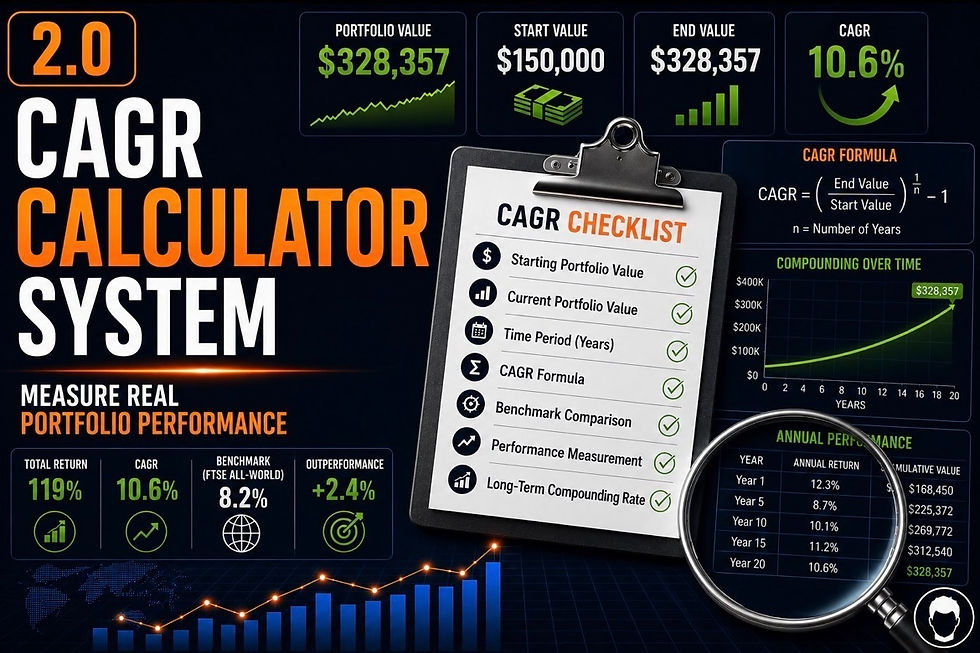
2) CAGR (Compound Annual Growth Rate)
CAGR answers: “How fast did my portfolio compound?”
This is usually the more important metric for long-term investors.
CAGR standardises returns over time so:
portfolios become comparable
strategies become measurable
compounding becomes visible
This is why CAGR becomes the core performance engine inside a structured investing system.
Hidden portfolio performance blind spots
Most investors think they understand performance because they can see whether their portfolio is “up.”
But serious portfolio tracking goes much deeper and can explain why sometimes your returns feel wrong.
A structured performance review often reveals:
benchmark underperformance
hidden concentration risk
allocation drift
misleading total return figures
inconsistent compounding
Without proper tracking, investors often:
mistake bull markets for skill
underestimate risk
overestimate diversification
fail to identify weakening performance trends
This is why performance tracking should function as a strategic decision-making system — not just a dashboard.
Many investors also fail to distinguish between strong performance and concentrated risk. A portfolio can outperform temporarily simply because one sector, ETF, or individual holding became dominant without the investor fully realising how much risk concentration has increased underneath the surface.
The Real Issue Is Visibility
Most investors can see:
• account values
• recent gains
• individual holdings
Few can see:
• actual compounding rate
• benchmark performance
• performance efficiency
This is why performance tracking is ultimately a visibility problem.
Why most tracking methods fail
Broker apps often don’t calculate properly once you add deposits/withdrawals.
Spreadsheets don’t handle cash flows well unless they’re structured carefully.
No consistency: people track randomly, change methods, or stop when markets drop.
Accurate investment performance tracking needs a repeatable structure.
See related guide Best Portfolio Tracker Excel Template
What good portfolio performance actually looks like
Good investing performance is not:
chasing short-term returns
outperforming during speculative markets
having one exceptional year
Good long-term performance usually looks like:
Consistent CAGR over time
Controlled volatility
Stable allocation discipline
Regular contributions
Benchmark outperformance
Repeatable decision-making
The best investors are often:
more disciplined
more structured
more consistent
— not simply better stock pickers. That is why proper tracking systems matter.

Most investors think good performance means making money. Structured Compounders think good performance means:
• repeatable performance
• measurable performance
• benchmarked performance
• sustainable performance
The strongest investors are not necessarily better stock pickers.
They are better measurers.
What The Assessment Reveals
Most investors believe performance tracking is about returns. The assessment reveals something deeper. It identifies:
✓ Investor Type
✓ Investor Score
✓ Benchmarking Discipline
✓ Compounding Strength
✓ Biggest Blind Spot
✓ Personalised Dashboard
Because understanding why performance occurs is usually more valuable than measuring it.
Take the free 2-minute Investor Assessment
What a real portfolio performance system tracks
Metric | Why it matters |
CAGR | Measures long-term compounding |
Total Return | Shows overall gain |
Benchmark Variance | Shows relative performance |
Contribution Tracking | Separates deposits from returns |
Allocation Drift | Identifies hidden concentration risk |
Tracks income compounding | |
Sector Exposure | Shows portfolio concentration |
Geographic Allocation | Reveals regional dependency |
Advanced investors also track benchmark-relative performance, sector concentration, geographic exposure, dividend growth, and position sizing rules to ensure portfolio performance is sustainable rather than dependent on short-term momentum.
Real Investor Mini Case Study (Japan 🇯🇵) : Was It Investing Skill — Or Just New Money?
A Japanese investor had been investing consistently for almost nine years.
Every month they invested the equivalent of approximately US$1,200 into a diversified portfolio of global equity funds and high-quality dividend companies.
When they logged into their brokerage account, the results looked impressive.
Their portfolio had grown from approximately US$138,000 to US$336,000.
The investor believed their portfolio was compounding at around 12% per year.
Everything appeared to be on track. A structured portfolio performance review revealed a different story.
What The Review Revealed
The review separated portfolio growth into two components:
Portfolio Value: US$336,400
Investor Contributions: US$129,600
Investment Growth: US$68,800
Total Return: 60.0%
Actual Portfolio CAGR: 7.8%
Benchmark CAGR: 9.4%
Performance Gap: –1.6% per year
The portfolio had grown steadily. But almost two-thirds of that growth came from disciplined monthly investing rather than investment performance alone.
The investor had been measuring wealth accumulation. They had never measured how efficiently their investments were compounding.

The Real Issue
The issue wasn’t: stock selection
The issue wasn’t: regular investing
The issue wasn’t: long-term discipline
The issue was: performance visibility.
The investor knew how much money was in the portfolio.
They didn’t know how much of that wealth had been created by investment performance rather than regular contributions.
Without separating the two, genuine compounding couldn’t be measured.
What Changed
The investor introduced:
CAGR tracking
Contribution-adjusted performance reporting
Benchmark comparisons
Annual performance reviews
Nothing changed about the portfolio.
Nothing changed about the monthly contributions.
Everything changed about how investment performance was measured.
For the first time, the investor could distinguish between saving more money and earning better returns—a crucial step towards becoming a Structured Compounder.
Why Most Investors Need More Than A Spreadsheet:
This is what serious investors use:
Spreadsheet→ records data
Dashboard → creates visibility
Assessment → identifies weaknesses
System → improves decisions
Membership → maintains discipline

The real challenge is not building a spreadsheet — it is building a repeatable investment operating system that remains accurate as contributions, allocation changes, rebalancing decisions, and portfolio complexity increase over time.
Common performance tracking mistakes
Confusing portfolio growth with portfolio performance
Ignoring contributions and withdrawals
Looking only at account balances
Tracking inconsistently across accounts
Measuring returns without benchmarking
Focusing only on winning holdings
Ignoring allocation drift
Using spreadsheets without structure
Many investors also underestimate the behavioural side of performance tracking. Emotional reactions to volatility, inconsistent review processes, and constantly changing strategy frameworks often create more performance leakage than stock selection itself.
Most investors are not actually measuring performance properly — they are estimating it.
Most of these mistakes are not technical.
They are behavioural.
The assessment helps identify which behaviours are creating performance leakage.
Without vs with a system
Without a system | With a system |
Guessing based on account value | Structured CAGR tracking |
Emotional reactions to price moves | Consistent long-term analysis |
Returns separated properly | |
No benchmark comparison | Relative performance visibility |
Hidden concentration risk | Allocation visibility |
Random review process | Repeatable tracking framework |
Who this is for
Investors who aren’t sure what their real performance is.
Anyone relying on broker dashboards for “returns”.
Long-term investors who want consistent, comparable tracking.
Who This Is NOT For
This guide is probably not for you if:
you only care whether your portfolio is up today
you are focused on short-term trading
you do not want to measure performance consistently
you are not interested in compounding
you prefer speculation over structured investing
Most Investors Have Hidden Performance Blind Spots

Most portfolios contain at least 2–3 of these issues.
The assessment frequently reveals:
• contribution distortion
• benchmark underperformance
• concentration risk
• performance measurement errors
Most investors discover at least two or three of these weaknesses.
What Type Of Investor Are You?
Most investors track performance. Structured Compounders understand performance.
The Investor Assessment reveals:
✓ Investor Type
✓ Investor Score
✓ Performance Visibility
✓ Compounding Strengths
✓ Compounding Weaknesses
✓ Progression Stage
✓ Recommended Next Step
Assessment
→ Dashboard
→ Intelligence Report
→ System
→ Membership
Takes less than two minutes.
FAQ
What’s the difference between portfolio value and portfolio performance?
Portfolio value includes deposits and withdrawals. Portfolio performance measures what your investments actually earned.
Why is CAGR more useful than total return?
Total return tells you how much you made. CAGR tells you how efficiently your portfolio compounded over time.
Why do broker apps often give misleading performance visibility?
Most broker apps focus on balances and short-term movement rather than contribution-adjusted returns, benchmarking, and long-term compounding.
How often should I track portfolio performance?
Monthly is usually ideal. The important thing is consistency.
What should a proper performance tracking system include?
At minimum:
CAGR
total return
historical performance analysis
Is Excel good for tracking portfolio performance?
Yes — but only if the spreadsheet is structured properly. Most spreadsheets become fragile because they are inconsistent and manually maintained.
Explore The Full Framework
The Investor Progression Model White Paper |
This article forms part of the Investor Progression Model — a framework for identifying how investors progress from reactive decision-making to structured long-term compounding. Inside the white paper: ✓ The four investor types ✓ The progression pathway ✓ The five dimensions of investor maturity ✓ How Structured Compounders build repeatable systems ✓ The research behind the Investor Assessment |
⬇ READ THE WHITE PAPER ⬇ |
Related Guides
Continue Your Portfolio Review
Learn how to calculate your true annualised investment return and measure long-term compounding accurately.
Discover how to compare your portfolio against the right benchmark and separate investment skill from market performance.
Understand why many investors misjudge their portfolio performance and uncover the hidden blind spots affecting long-term returns.
Explore the systems, behaviours and portfolio structure that help Structured Compounders achieve more consistent long-term investment results.
Final Thought
Most investors believe they’re tracking portfolio performance because they know their account value and recent gains. In reality, effective performance tracking goes much deeper.
Understanding your CAGR, benchmarking against the right index and separating investment returns from cash contributions gives you a far clearer picture of how effectively your wealth is compounding over time.
The strongest investors don’t simply measure performance—they understand what that performance reveals about their investment process and use those insights to make better long-term decisions.
That’s one of the defining characteristics of a Structured Compounder.


Comments