3.15 – Growth vs Value Investing: How Should You Allocate Your Portfolio?
Two Investment Styles. Different Sources of Return. One Deliberate Portfolio.
Growth and value are two of the most established approaches to investing in stocks.
Growth investors typically favour companies expected to increase revenues, earnings and cash flows relatively quickly.
Value investors typically favour companies trading at lower valuations relative to measures such as earnings, cash flow, assets or other fundamentals.
At first, the distinction appears straightforward:
Growth → Pay More for Expected Future Growth
Value → Pay Less for Existing Fundamentals
But portfolio construction makes the decision more complicated. Imagine two investors each have a $1 million equity portfolio. The first holds:
$750,000 Growth
$250,000 Value
The second holds:
$250,000 Growth
$750,000 Value
Both investors own diversified portfolios.
Both own successful businesses.
Both are fully invested in stocks.
But their portfolios may behave very differently.
The growth-heavy portfolio may have greater exposure to companies whose valuations depend heavily on expectations of substantial future earnings.
The value-heavy portfolio may have greater exposure to mature businesses, cyclical industries and companies whose valuations reflect lower expectations.
That can create very different exposure to:
Valuation + Interest Rates + Economic Growth + Sector Performance + Market Sentiment
And there is another complication. Many investors already have a substantial growth or value allocation without deliberately choosing one.
A broad-market ETF may contain both.
Individual stock selections can create additional exposure.
Sector funds can reinforce it.
Several individually sensible investment decisions can therefore combine to create a substantial portfolio tilt. The Investor may believe:
“I choose companies individually.”
But the portfolio may reveal:
“I repeatedly choose companies with similar investment characteristics.”
That distinction matters. Because the relevant question isn’t simply:
“Is growth better than value?”
Nor is it:
“Which style will outperform next?”
The more useful question is:
“What growth and value exposure does my portfolio already contain — and is that allocation deliberate?”
A growth allocation may increase exposure to companies capable of substantial expansion.
A value allocation may provide exposure to businesses priced at lower multiples of current fundamentals.
Both can contribute to long-term returns.
Both can underperform for extended periods.
And neither should automatically be added simply because the other has recently performed better. The allocation should instead emerge from:
Existing Exposure + Portfolio Objectives + Diversification + Risk + Intended Style Tilt
In this guide, we’ll examine how growth and value investing work, what drives their returns, why leadership between them changes, how apparently diversified portfolios can develop unintended style concentrations and how Structured Compounders decide whether either style deserves a deliberate portfolio tilt.

Who This Guide Is For
This guide is designed for long-term investors who want to think more deliberately about how growth and value exposure should work within their investment portfolio. It will be particularly valuable if you:
own both growth and value stocks but aren’t sure about the overall balance
invest through ETFs or index funds and want to understand their underlying style exposure
are considering adding a dedicated growth or value fund
have accumulated substantial exposure to large growth companies
want to understand whether value investing adds meaningful diversification
are unsure how valuation affects long-term investment outcomes
want to understand why growth and value leadership changes
are concerned that recent performance may be influencing your allocation decisions
want to distinguish a deliberate style tilt from accidental portfolio concentration
want to understand how sector exposure interacts with growth and value
want a more structured approach to portfolio allocation
are progressing towards becoming a Structured Compounder
The central question changes as investors become more sophisticated.
An early-stage investor may ask:
“Should I buy growth stocks or value stocks?”
A developing investor asks:
“Which style performs better?”
A more structured investor asks:
“How much growth and value exposure does my portfolio already contain?”
A Structured Compounder goes further:
“What role should each exposure perform — and how much influence do I deliberately want it to have over my portfolio?”
That is the progression this guide explores.
What You'll Learn | |
Growth vs Value | How the two investment styles differ and why the distinction is more complicated than simply expensive stocks versus cheap stocks. |
Growth Investing | Why investors may pay higher valuations for companies expected to expand earnings substantially. |
Value Investing | Why lower valuations can create opportunities but don’t automatically mean a company is undervalued. |
Valuation | Why the price paid for future earnings can materially affect investment outcomes. |
Risk & Return | How growth and value portfolios can create different sources of risk and return. |
Market Cycles | Why leadership between growth and value can change significantly over time. |
Interest Rates | Why changing interest rates and discount rates can affect growth and value companies differently. |
Sector Exposure | How an apparent growth or value allocation can also create substantial underlying sector exposure. |
Diversification | Whether combining growth and value can improve portfolio structure rather than simply increase the number of holdings. |
Style Allocation | How to distinguish deliberate growth-value exposure from a tilt that has accumulated unintentionally. |
Investor Progression Model | How investors progress from choosing investment styles towards deliberately allocating their influence within the portfolio. |
Contents
Growth vs Value Investing: What’s the Difference?
How Growth Investing Actually Works
How Value Investing Actually Works
What Role Should Growth Stocks Play in a Portfolio?
What Role Should Value Stocks Play in a Portfolio?
How Much Should You Allocate to Growth and Value?
What Determines the Right Growth-Value Allocation?
How Growth and Value Change Portfolio Risk
Why Growth and Value Leadership Changes Over Time
How Interest Rates Affect Growth and Value Stocks
When a Growth Tilt May Be Rational
When a Value Tilt May Be Rational
Real Investor Case Study — Montreal, Quebec 🇨🇦
What the Review Revealed
The Real Issue
What Changed
The Investor Progression Model: From Choosing Styles to Allocating Purpose
Common Growth and Value Allocation Mistakes
Growth vs Value Allocation Comparison
Quick Growth-Value Allocation Audit
Who This Guide Is For
Who This Guide Is NOT For
FAQ
Explore The Full Framework
Related Articles
Final Thought
Growth vs Value Investing: What’s the Difference?
Growth and value investing describe two different ways of identifying where future investment returns may come from.
Growth investors typically focus on companies expected to increase revenues, earnings or cash flows faster than the wider market.
Value investors typically focus on companies whose shares trade at relatively low valuations compared with measures such as earnings, cash flow, assets or estimated underlying value.
At the simplest level:
Growth → Invest in Future Expansion
Value → Invest at a Lower Price Relative to Current Fundamentals
Imagine two companies each earning $5 per share.
Company A trades at $150 per share.
Company B trades at $60 per share.
Their price-to-earnings ratios would be:
Company A → 30× Earnings
Company B → 12× Earnings
The growth investor may accept Company A’s higher valuation because they expect its earnings to expand substantially.
The value investor may prefer Company B because the current share price requires less future growth to justify the valuation.
But neither label tells you whether the investment will ultimately be successful.
A rapidly growing company can still produce disappointing investment returns if investors paid too much for that growth.
A statistically cheap company can remain cheap — or become cheaper — if its underlying business deteriorates.
The return ultimately depends on the interaction between:
There is also no permanent dividing line between growth and value.
A company considered a growth stock today could eventually mature and trade at a much lower valuation.
A value company could improve its economics and begin growing more rapidly.
That is why Structured Compounders don’t treat growth and value as opposing investment tribes. They ask:

How Growth Investing Actually Works
Growth investing is based on the idea that some companies can expand their economic value substantially over time. These businesses may be increasing:
revenue
earnings
free cash flow
market share
customers
geographic reach
products or services
If that expansion continues for long enough, the underlying business can become significantly more valuable. The basic investment thesis is:
Business Growth → Earnings Growth → Increasing Business Value → Potential Shareholder Returns
Imagine a company earning $2 per share.
If earnings compound at 20% annually for ten years, earnings would grow to approximately $12.38 per share.
That transformation can create enormous economic value. But growth investing introduces an additional variable.
The price paid for that expected growth.
Suppose investors already expect exceptional performance and therefore value the company at a very high multiple.
The company might continue growing strongly while its share price produces much weaker returns because the valuation investors are willing to pay declines. Conceptually:
Investment Return ≠ Business Growth Alone
Instead:
This is one of the most important distinctions in growth investing. A great company isn’t automatically a great investment at every price. Growth investors are therefore making two connected judgements:
How Much Can the Business Grow?
and:
How Much of That Growth Is Already Reflected in the Price?
The more optimistic the valuation, the more future success may already be embedded within the share price. That creates the central tension within growth investing:
Greater Future Growth Potential ↔ Greater Dependence on Future Expectations Being Met
Structured Compounders therefore don’t simply ask whether a company is growing. They ask:
“What growth am I paying for — and what has to happen for that price to be justified?”
How Value Investing Actually Works
Value investing approaches the same problem from a different direction. Instead of beginning with rapid future growth, the investor begins with the relationship between:
Price Paid ↔ Economic Value Received
Value stocks often trade at lower multiples of:
earnings
cash flow
book value
sales
dividends
But a low valuation alone doesn’t make an investment attractive.
Imagine two companies each earning $5 per share.
One trades at 10× earnings, giving it a share price of $50.
The other trades at 25× earnings, giving it a share price of $125.
The first company appears substantially cheaper. But why?
Perhaps investors are overlooking a fundamentally sound business.
Perhaps the company is temporarily unpopular.
Perhaps earnings are depressed but recoverable.
Or perhaps the low valuation reflects genuine problems that will become progressively worse.
This creates the central challenge of value investing:
Undervalued Business
versus:
The second is often described as a value trap.
A company can appear inexpensive on historical financial measures while its competitive position, profitability or long-term economics deteriorate.
Successful value investing therefore requires more than screening for low valuation multiples. The underlying thesis is closer to:
The potential return can then come from several sources:
Underlying Earnings + Dividends + Business Improvement + Valuation Re-Rating
If investors eventually become willing to pay a higher valuation for the same earnings, the share price can rise even without exceptional business growth. Structured Compounders therefore don’t ask:
“Which stocks look cheapest?”
They ask:
“Why is this investment cheap — and what evidence suggests the market price understates its long-term economic value?”
What Role Should Growth Stocks Play in a Portfolio?
The primary portfolio role of growth stocks is exposure to businesses capable of substantial long-term expansion. That can provide exposure to:
rapidly expanding industries
technological change
increasing market penetration
new products and services
scalable business models
companies reinvesting capital at attractive rates
businesses capable of compounding earnings for long periods
Consider a $1 million equity portfolio containing:
$650,000 Broad-Market Equities
$250,000 Growth Stocks
$100,000 Value Stocks
The $250,000 growth allocation isn’t simply another collection of companies.
It deliberately increases the portfolio’s exposure to businesses whose value depends more heavily on future expansion. The Investor is effectively saying:
“I want part of my portfolio to have greater exposure to companies capable of compounding their businesses substantially over time.”
That can be rational. But it changes the portfolio. Growth-heavy allocations can become more sensitive to:
High Valuations + Earnings Expectations + Interest Rates + Market Sentiment + Sector Concentration
This matters because growth exposure can accumulate without being explicitly labelled as such. An Investor might own:
Each investment can appear reasonable independently.
Together, they may create a much larger growth tilt than intended.
The correct question therefore isn’t:
“Do I own enough growth stocks?”
It is:
“How much growth exposure does my portfolio already contain, and what role do I want that exposure to perform?”
What Role Should Value Stocks Play in a Portfolio?
The primary portfolio role of value stocks is exposure to companies priced more conservatively relative to their current fundamentals. These businesses may offer exposure to:
lower starting valuations
established earnings and cash flows
dividend income
mature industries
cyclical recovery
improving business fundamentals
potential valuation re-rating
Value exposure can also change the composition of a portfolio that has become heavily tilted towards highly valued growth businesses. Suppose a $1 million equity portfolio has gradually developed:
$750,000 Growth-Oriented Exposure
$250,000 Value-Oriented Exposure
Adding value exposure could reduce dependence on the same valuation and earnings expectations that dominate the growth allocation. But that doesn’t mean:
A value portfolio may itself contain substantial concentrations.
Financials, energy, industrials or other mature sectors can become disproportionately influential depending on how the portfolio or value index is constructed.
And value stocks introduce their own risks. A low valuation may reflect:
Weak Growth + Cyclical Exposure + Financial Leverage + Structural Decline + Deteriorating Competitive Position
The portfolio role should therefore not be:
“Value stocks are cheaper, so they are safer.”
A more useful formulation is:
Growth → Greater Exposure to Future Business Expansion
Value → Greater Exposure to Lower Starting Valuations and Potential Re-Rating
Neither is inherently superior. Structured Compounders ask:
“Does adding value exposure genuinely diversify the economic drivers of my portfolio — or am I simply adding another investment label?”
How Much Should You Allocate to Growth and Value?
There is no universal growth-value allocation. An equity portfolio could reasonably be:
Broad Market Only
Broad Market + Growth Tilt
Broad Market + Value Tilt
Growth + Value
or constructed through individual companies without explicit style targets at all.
The important point is that growth and value allocation should be an output of the portfolio-construction process, not a percentage chosen in isolation.
Consider three investors.
Investor A — Broad-Market Investor
The Investor owns a diversified global equity portfolio and has no strong reason to favour either style. A separate growth or value allocation may be unnecessary because the underlying portfolio already provides exposure to both.
Investor B — Deliberate Growth Tilt
The Investor understands that the existing portfolio is diversified but deliberately wants greater exposure to businesses capable of substantial long-term expansion. The portfolio might therefore contain:
Investor C — Deliberate Value Tilt
The Investor’s existing portfolio has become heavily exposed to highly valued growth companies. They deliberately introduce value exposure to change the portfolio’s underlying style characteristics. The structure might become:
Core Broad-Market Exposure + Controlled Value Tilt
The percentages themselves are secondary. What matters is why they exist. A useful process is:
This also prevents a common mistake.
If growth has substantially outperformed value, increasing growth exposure may feel rational precisely when the portfolio has already become more growth-heavy through market appreciation.
The same can happen after a period of strong value performance. That turns allocation into performance chasing. The Structured Compounder instead asks:
“If I were constructing this portfolio from scratch today, what growth-value exposure would I deliberately choose — and why?”
The objective isn’t to discover the perfect split.
It is to ensure that whatever split exists is understood, intentional and consistent with the role each investment style is expected to perform.
What Determines the Right Growth-Value Allocation?
The appropriate growth-value allocation depends less on choosing which style is “better” and more on understanding what exposure already exists within the portfolio.
This matters because an Investor can create a substantial style tilt without ever deliberately choosing one.
A portfolio containing a broad US index, a technology ETF and several large technology stocks may already have considerable growth exposure. Adding a dedicated growth fund could strengthen an allocation that is already dominant.
The same principle applies to value. Several dividend funds, financial stocks and value ETFs could create a much larger value tilt than the Investor realises.
The starting point should therefore be:
Existing Portfolio Exposure
Before:
Desired Portfolio Exposure
Several factors influence that decision.
Existing Style Exposure
The first question is what the portfolio already contains. Look through individual stocks, ETFs and funds rather than relying solely on investment labels. The relevant question is:
“If I classify the underlying economic exposure of my portfolio, how much already behaves like growth and how much like value?”
Sector Exposure
Growth and value allocations frequently carry substantial sector characteristics. A growth tilt may increase exposure to technology and other industries containing businesses with high expected growth. A value tilt may increase exposure to financials, energy, industrials and other mature or cyclical industries.
The decision can therefore become:
without the Investor necessarily recognising both.
Valuation
The price being paid for each style matters. A portfolio can have a sensible strategic reason for owning growth companies while still becoming increasingly dependent on optimistic valuations. Likewise, a value allocation can appear statistically inexpensive while containing businesses facing genuine economic deterioration.
Diversification
Adding another investment only improves diversification if it changes the portfolio’s underlying exposure. The useful question isn’t:
“Do I own both growth and value funds?”
It is:
Investment Philosophy
Some investors deliberately maintain a neutral style exposure through broad-market funds. Others intentionally tilt towards growth or value because they have a defined investment rationale.
Neither requires predicting which style will outperform next. What matters is whether the tilt is:
The overall framework becomes:
Existing Exposure + Sector Exposure + Valuation + Diversification + Investment Philosophy
↓
Desired Growth-Value Exposure
↓
Portfolio Allocation
The percentage should be the output of that process.
Not the starting point.
How Growth and Value Change Portfolio Risk
Growth and value don’t simply provide different routes to return. They can expose the portfolio to different types of risk. Consider two hypothetical $1 million equity portfolios.
Portfolio A — Growth Heavy
$750,000 Growth
$250,000 Value
Portfolio B — Value Heavy
$250,000 Growth
$750,000 Value
Both portfolios are fully invested in equities. Neither is automatically safer. But the risks influencing their outcomes may be different. The growth-heavy portfolio may be more exposed to:
High Valuations + Future Earnings Expectations + Interest Rates + Multiple Compression + Growth-Sector Concentration
The value-heavy portfolio may be more exposed to:
Economic Cyclicality + Financial Leverage + Mature Industries + Structural Decline + Value Traps
This creates an important distinction.
An investment can appear relatively stable while carrying significant fundamental risk. Likewise, a volatile growth company can still possess exceptional underlying economics.
The objective isn’t therefore to identify which style has “less risk.” It is to understand:
Which Risks Are Being Added?
How Large Are They?
This becomes particularly important when a portfolio appears diversified by number of holdings.
Twenty value stocks can still depend heavily on the same economic conditions.
The more useful framework is:
Structured Compounders therefore don’t ask:
“Which is safer — growth or value?”
They ask:
“What risks become more influential as I increase either allocation?”
Why Growth and Value Leadership Changes Over Time
One of the most dangerous assumptions in style investing is that whichever strategy has performed best recently has become permanently superior.
Growth and value can each experience extended periods of relative strength and weakness. That happens because market conditions change. Different environments can favour different combinations of:
economic growth
corporate earnings
inflation
interest rates
investor expectations
sector performance
starting valuations
risk appetite
Growth stocks can perform exceptionally well when rapidly expanding companies continue exceeding expectations and investors remain willing to pay substantial valuations for future earnings.
Value stocks can perform strongly when previously discounted businesses recover, economic conditions improve or investors become willing to pay higher valuations for companies that had been priced pessimistically.
This creates a recurring behavioural problem. After several years of strong growth performance, investors may conclude:
“Growth Investing Works Better.”
After a period of strong value performance, the conclusion can reverse:
“Value Investing Is Back.”
But the portfolio decision is being made after relative performance has already changed. The cycle can become:
Style Outperforms → Investor Confidence Increases → Allocation Increases → Leadership Changes → Disappointment → Allocation Changes Again
The problem isn’t that investors recognise changing market conditions.
The problem is allowing recent returns to substitute for an investment process.
A Structured Compounder separates:
from:
Recent Performance
The question isn’t:
“Which style has been winning?”
It is:
“Has anything changed about the reason I hold this allocation?”
How Interest Rates Affect Growth and Value Stocks
Interest rates can influence the relative behaviour of growth and value stocks because the timing of expected future cash flows differs between companies.
Growth companies are often valued partly on earnings and cash flows expected much further into the future.
When investors value those future cash flows, they effectively translate them into what they are worth today.
The further into the future the expected cash flow occurs, the more sensitive that present value can be to the rate used to discount it. Conceptually:
Lower Discount Rate → Future Cash Flows Become More Valuable Today
Higher Discount Rate → Future Cash Flows Become Less Valuable Today
That can make highly valued growth companies particularly sensitive to changes in interest rates and required returns.
Imagine a company whose investment case depends heavily on profits expected many years from now.
If investors suddenly require a higher return to justify owning the shares, they may become unwilling to pay the same valuation multiple for those distant earnings.
The business doesn’t necessarily have to deteriorate. The valuation applied to the business can change.
Value companies often derive a larger proportion of their perceived value from current earnings, assets or nearer-term cash flows.
That can make their valuations differently sensitive to changes in discount rates. But the relationship isn’t mechanical.
Higher rates can also damage value companies. Banks, industrial businesses, property-related companies and highly leveraged firms can all respond differently depending on why rates are changing and how those changes affect the economy.
So the rule isn’t:
Rates Rise → Value Wins
or:
Rates Fall → Growth Wins
A more useful relationship is:
↓
Different Effects Across Different Businesses
Structured Compounders therefore treat interest rates as one factor affecting portfolio exposure.
Not as a signal for switching repeatedly between growth and value.
When a Growth Tilt May Be Rational
A growth tilt may be rational when an Investor deliberately wants greater exposure to businesses capable of compounding revenues, earnings and cash flows substantially over long periods.
The important word is deliberately.
A growth tilt is different from simply owning growth stocks because they have recently performed well. A deliberate tilt may make sense where the Investor:
has a long investment horizon
wants greater exposure to companies capable of substantial reinvestment and expansion
understands that higher expected growth can come with higher valuations
accepts the possibility of significant valuation compression
has assessed existing growth exposure across the whole portfolio
understands any resulting sector concentration
can tolerate extended periods when value outperforms
has a defined limit on how large the tilt should become
Suppose an Investor begins with:
80% Broad-Market Equity
20% Deliberate Growth Tilt
That 20% allocation has a clearly defined purpose.
It increases exposure to growth characteristics without allowing them automatically to dominate the entire portfolio.
But the Investor should still look through the broad-market allocation.
If the core portfolio already contains substantial growth exposure, the actual portfolio tilt may be considerably larger than the headline 20%. That creates the distinction between:
and:
Underlying Exposure
A rational growth tilt therefore begins with the question:
“What additional exposure am I trying to create?”
Not:
“Which growth investments should I buy?”
When a Value Tilt May Be Rational
A value tilt may be rational when an Investor deliberately wants greater exposure to companies trading at lower valuations relative to their underlying fundamentals.
That could provide exposure to different return drivers from those dominating a growth-heavy portfolio. A deliberate value tilt may make sense where the Investor:
wants to reduce dependence on highly valued growth companies
understands why the selected companies or funds are classified as value
accepts that cheap companies can remain cheap for long periods
understands the risk of value traps
wants exposure to potential valuation re-rating
has assessed the sectors underlying the value allocation
can tolerate prolonged periods of value underperformance
has a defined allocation rather than continually increasing exposure because something appears cheap
has a process for monitoring whether the original investment thesis remains intact
Imagine an Investor whose portfolio has gradually become:
70% Growth-Oriented Exposure
30% Other Equity Exposure
The Investor might decide that greater value exposure would reduce dependence on the same growth and valuation characteristics. The objective isn’t:
“Value is due to outperform.”
It is:
“My portfolio is more dependent on one investment style than I want it to be.”
That distinction is critical.
A value allocation based on forecasting the next market cycle is a tactical market view.
A value allocation based on deliberately changing the portfolio’s underlying exposures is a portfolio-construction decision.
The process becomes:
Identify Existing Growth Concentration → Define Desired Diversification → Determine Value Allocation → Monitor Resulting Exposure
And the same discipline applied to growth should apply to value. The Structured Compounder doesn’t add value because it has underperformed and therefore “must be due.” They ask:
“What portfolio problem does this value allocation solve — and how much capital is required to solve it?”
Discover What Your Growth-Value Allocation Reveals About You
Holding both growth and value investments doesn’t automatically make an investment portfolio more diversified. The important question is whether your allocation between growth and value reflects the return drivers, valuation characteristics and risks the portfolio you are trying to build actually requires.
The Free Investor Assessment helps identify:
growth-value allocation and asset-allocation blind spots
whether your portfolio has developed an unintended growth or value tilt
whether your growth and value exposures have clearly defined roles within your portfolio
your current Investor Progression Model stage
practical next steps towards becoming a Structured Compounder
Because successful style allocation isn’t about predicting whether growth or value will outperform next or changing your portfolio whenever market leadership changes.
It’s about understanding what role growth and value should each perform, how much exposure you already have and whether your allocation supports the long-term portfolio you are trying to build.
Only takes 2-minutes • manually reviewed • delivered within 24 hours
The Investor Who Used Growth to Balance a Value-Heavy Financial Life
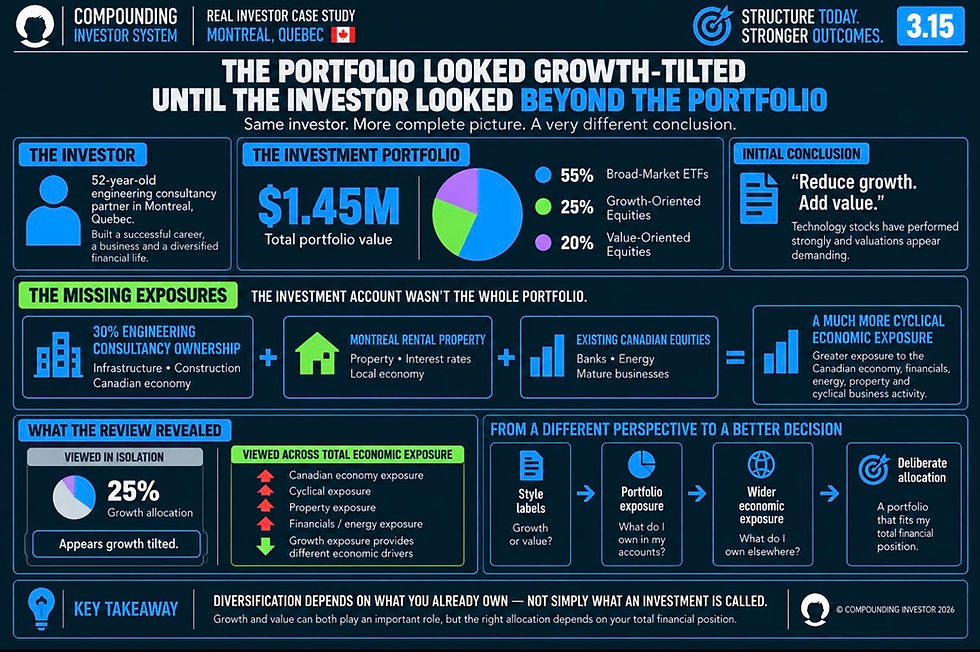
The Investor was a 52-year-old engineering consultancy partner living in Montreal.
He had built a $1.45 million investment portfolio across registered and taxable accounts and considered himself a relatively balanced investor.
His equity portfolio appeared to support that view:
Broad-Market ETFs → 55%
Growth-Oriented Equities → 25%
Value-Oriented Equities → 20%
At first glance, the portfolio looked moderately tilted towards growth but broadly diversified. The Investor had recently considered reducing the growth allocation.
Technology stocks had performed strongly, valuations appeared demanding and several financial articles he had read argued that investors should increase value exposure. His proposed change was:
Growth 25% → 10%
Value 20% → 35%
Viewed only through the investment account, the change appeared reasonable.
But the portfolio review revealed something the Investor had overlooked.
The Investment Portfolio Was Only Part of His Economic Exposure
The Investor owned 30% of the engineering consultancy where he worked. The business generated substantial cash flow but its revenues were closely connected to infrastructure investment, construction activity and the Canadian economic cycle.
He also owned a rental property in Montreal.
And his existing Canadian equity holdings contained substantial exposure to banks, energy businesses and other mature companies.
When these exposures were considered together, his financial position looked very different. He already had substantial exposure to:
The proposed value tilt would have increased several of those exposures further. The problem wasn’t that value investing was inappropriate.
It was that the Investor had been evaluating growth and value inside the portfolio without considering the economic exposures outside it.
The Growth Allocation Was Performing a Different Role
His growth allocation contained predominantly global businesses whose revenues were less dependent on the same factors driving his consultancy, property and Canadian investments.
That changed the interpretation of the allocation. What initially appeared to be:
25% Growth → Potentially Excessive Style Tilt
looked different when viewed across his wider financial position:
Growth Exposure → Different Economic Drivers
The Investor wasn’t using growth because he believed growth stocks would outperform value stocks.
The allocation was providing exposure to businesses whose long-term outcomes depended on different sources of economic activity. This created a more useful distinction:
Investment Style Diversification
isn’t always the same as:
Economic Diversification
What The Review Revealed
The review identified three important issues.
First, the Investor had been assessing growth and value only within his investment accounts.
Second, his existing wealth was already more economically value-oriented and cyclical than the portfolio percentages suggested.
Third, increasing value exposure simply because growth valuations appeared high would have strengthened several risks already present elsewhere in his financial life.
The relevant question therefore changed from:
“Should I reduce growth and buy more value?”
to:
“What economic exposures does each part of my wealth contribute?”
That was a fundamentally different portfolio-construction problem.
The Real Issue
The Investor had treated growth-value allocation as though it existed independently from the rest of his financial position.
It didn’t.
His business ownership, property and Canadian investments already influenced the risks he was taking.
The investment portfolio therefore had an opportunity to provide exposures that were different, rather than simply reproducing those risks. The problem can be expressed as:
Portfolio Allocation Viewed in Isolation → Apparently Growth Tilted
But:
Portfolio + Business + Property + Existing Canadian Exposure → Much More Cyclical Economic Exposure
The labels had obscured the underlying structure.
What Changed
The Investor abandoned the proposed 10% growth / 35% value change.
He didn’t increase growth simply because the review had identified these wider exposures either. Instead, he gave each allocation a defined role.
His broad-market holdings remained the core of the portfolio.
His growth allocation provided controlled exposure to businesses and economic drivers that were less represented elsewhere in his financial position.
His value allocation remained meaningful, but he stopped treating additional value exposure as automatically diversifying.
Most importantly, future allocation decisions would be assessed against the Investor’s total economic exposure, not merely the percentages displayed inside his brokerage account. The progression was:
The Investor hadn’t discovered that growth was better than value.
He had discovered that the same investment can perform a very different portfolio role depending on what the Investor already owns elsewhere.
That is the transition towards becoming a Structured Compounder.
The Investor Progression Model: From Choosing Styles to Allocating Purpose
The Investor Progression Model helps explain how the growth vs value decision develops.
An early-stage investor often focuses almost entirely on labels:
“Should I invest in growth stocks or value stocks?”
The next stage starts comparing performance:
“Which performs better — growth or value?”
A more structured investor asks:
“What role should growth and value each play in my portfolio?”
The Structured Compounder goes one level further:
“What exposure does each style create — and how much influence do I deliberately want it to have?”
The progression becomes:
This changes how growth and value are interpreted. A growth investment isn’t simply:
A Company Expected to Grow Quickly
It represents exposure to a particular combination of future earnings expectations, valuation, sectors and economic drivers.
Similarly, a value investment isn’t simply:
A Cheap Company
It represents exposure to businesses priced differently relative to their current fundamentals, often with different sector, cyclical and valuation characteristics.
The Structured Compounder therefore stops viewing the decision as:
Growth vs Value
and starts viewing it as:
Different Sources of Portfolio Exposure
That means asking:
What growth exposure do I already have?
What value exposure do I already have?
What economic drivers sit underneath those labels?
Is either style already disproportionately influential?
Would adding growth or value genuinely diversify the portfolio?
What role would an intentional style tilt perform?
How large does that tilt need to be?
Would I maintain the allocation through a prolonged period of underperformance?
The objective isn’t to predict which style will outperform next.
It is to ensure that any growth-value allocation exists because it has a defined portfolio purpose rather than because recent market performance has made one style more attractive.
The Investor Progression Model illustrates the four stages of investor development — Reactive Investor, Lucky Investor, Conservative Compounder and Structured Compounder — and shows how portfolio construction can evolve from simply choosing investments towards deliberately allocating capital, controlling portfolio influence and managing concentration.

Common Growth and Value Allocation Mistakes
Growth and value investments can both form part of an effective long-term portfolio.
Problems develop when investors allocate between them without understanding what each style is contributing to the portfolio around it. Common mistakes include:
treating growth and value as competing investment identities
assuming growth companies automatically produce higher investment returns because their businesses grow faster
assuming value stocks are safer simply because they trade at lower valuations
confusing a low valuation with genuine undervaluation
ignoring the possibility that a cheap company may be a value trap
increasing growth exposure after a prolonged period of strong growth performance
increasing value exposure simply because value has underperformed and appears “due” to recover
adding a growth or value fund without examining the style exposure already contained within broad-market holdings
overlooking the sector concentrations created by growth and value allocations
assuming owning both growth and value automatically creates effective diversification
focusing on fund labels rather than underlying holdings and economic characteristics
allowing a deliberate style tilt to become much larger through portfolio drift
changing the allocation in response to interest-rate forecasts or short-term market narratives
treating growth-value allocation independently from business ownership, property or other significant financial exposures
selecting an arbitrary percentage split without defining what role either allocation should perform
judging a growth or value strategy from a short period of relative performance
having no process for reviewing whether the original reason for the style tilt remains valid
Perhaps the most important mistake is treating the decision as a choice between:
Growth Investor
or:
Value Investor
Neither description explains whether the portfolio itself is well constructed. A more structured process asks:
What exposure am I trying to obtain?
What role should it perform?
What exposure do I already have?
Does this allocation genuinely diversify the portfolio?
What sector and valuation characteristics come with it?
How much additional influence will the tilt create?
Would I maintain it through a prolonged period of underperformance?
What would cause me to change the allocation?
That changes the question from:
Growth or Value?
to:
What Purpose Should Each Style Serve?
A Structured Compounder doesn’t need to choose an investment identity. They decide what exposures the portfolio requires, how much influence each should have and why each deserves its allocation.
Growth vs Value Allocation Comparison
Growth and value aren’t opposing definitions of good and bad investing. They are different ways of obtaining exposure to companies with different growth expectations, valuations and economic characteristics.
Growth Allocation | Value Allocation |
Greater emphasis on companies expected to expand earnings relatively quickly | Greater emphasis on companies trading at lower valuations relative to fundamentals |
More of the investment case may depend on future earnings | More of the investment case may depend on existing earnings, assets or cash flows |
Often accepts higher starting valuations | Often begins with lower starting valuations |
Can benefit substantially from sustained business expansion | Can benefit from improving fundamentals and valuation re-rating |
Can be vulnerable to disappointing growth expectations | Can be vulnerable to structural deterioration and value traps |
May be more sensitive to changes in discount rates | May have different interest-rate and economic sensitivities |
Can create significant exposure to growth-heavy sectors | Can create significant exposure to mature or cyclical sectors |
Strong recent performance can increase the portfolio tilt automatically | Strong relative performance can also increase the portfolio tilt |
Asks: “How much future growth am I paying for?” | Asks: “Why is this investment cheap?” |
Neither approach removes the need for judgement. Growth allocation requires the Investor to decide:
Which Exposure → Which Valuation → Which Allocation → Which Portfolio Role
Value allocation requires additional questions:
Which Exposure → Why Is It Cheap? → Which Allocation → Which Portfolio Role
The appropriate structure is therefore the one where the Investor understands what exposure each allocation creates, why it exists and how much influence it should have over portfolio outcomes.
Quick Growth-Value Allocation Audit
Ask yourself:
✓ Do I know how much growth and value exposure my portfolio already contains?
✓ Have I looked through my ETFs and funds rather than relying solely on their names?
✓ Can I explain why I have any deliberate growth or value tilt?
✓ Do I understand the valuation characteristics of each allocation?
✓ Have I identified the sector exposures underneath my growth and value holdings?
✓ Am I genuinely diversifying economic drivers or simply adding another investment style?
✓ Would I choose the same growth-value allocation if I were constructing the portfolio today?
✓ Has recent performance influenced how much I want to allocate to either style?
✓ Would I maintain my chosen allocation if the other style outperformed for several years?
✓ Do I understand how a substantial change in interest rates could affect different parts of the portfolio?
✓ Have I considered significant economic exposures outside my investment portfolio?
✓ Do I have a process for monitoring whether a deliberate style tilt becomes too influential?
If several answers are “No”, the issue may not be whether you should own more growth or more value.
It may be that the portfolio lacks a clear framework for deciding what role each style should perform and how much influence it should have.
Who This Guide Is For
This guide is designed for long-term investors deciding what role growth and value should play within their portfolio. It will be particularly valuable if you:
own a broad-market portfolio but are considering a growth or value tilt
already own dedicated growth or value funds
hold individual stocks with very different valuation and growth characteristics
want to understand how much style exposure your portfolio already contains
are concerned that recent market performance may be influencing your allocation
want to understand how valuation affects long-term investment outcomes
want to identify sector concentrations hidden underneath style allocations
are questioning whether growth and value genuinely diversify each other
want to understand how interest rates can affect different parts of your equity portfolio
have significant business, property or other economic exposures outside your investment portfolio
want a clearer framework for determining whether a style tilt has a genuine portfolio purpose
are progressing towards becoming a Structured Compounder
The objective isn’t to determine whether growth or value is universally superior.
It is to understand which exposure is appropriate for each job within your portfolio.
Who This Guide Is NOT For
This guide is unlikely to be useful if you:
want a list of growth stocks to buy
want a list of value stocks to buy
want a universal percentage split between growth and value
want to predict which style will outperform next
assume faster-growing companies automatically produce higher investment returns
assume low-valuation companies are automatically safer
want recent market performance to determine your allocation
want to switch repeatedly between growth and value based on interest-rate forecasts
aren’t prepared to examine the underlying holdings inside your funds
want a style label rather than a portfolio-construction framework
It is also not an argument that every Investor should deliberately combine growth and value. A broad-market portfolio containing both styles can be entirely coherent.
So can a portfolio with a deliberate and controlled tilt towards one style. The important question is whether the allocation reflects a deliberate investment process rather than an investment identity.
Discover What Your Growth-Value Allocation Reveals About You
Most investors already know roughly how their portfolio is allocated. They can see:
Their individual holdings
Their growth investments
Their value investments
Their sector allocation
Their largest positions
Their total portfolio value
Yet many still cannot answer some of the most important questions about their overall investment process.
Why do I actually have this level of exposure to growth and value?
Is my current growth-value allocation deliberate or simply the result of the investments I have accumulated?
What role are growth and value actually performing within my portfolio?
What stage of the Investor Progression Model am I currently at?
What should I change to become a more structured long-term investor?
Your portfolio may already contain what appears to be a sensible combination of growth and value investments. But owning both styles isn’t the same as understanding what exposure each creates or what role each should perform within your overall investment strategy.
The Free Investor Assessment helps identify:
hidden weaknesses in your portfolio-allocation process
your current Investor Progression Model stage
growth-value allocation, concentration and diversification blind spots
opportunities to build a more structured investment system
practical next steps towards becoming a Structured Compounder
Because the best investors don’t simply decide whether they prefer growth or value. They understand why each exposure exists, what purpose it serves and what would justify changing the allocation.
And once those decisions are deliberate, you can make far better decisions about valuation, diversification, sector exposure, portfolio risk, rebalancing, asset allocation and long-term compounding.
Takes Less Than 2-Minutes
FAQ
Is growth investing better than value investing?
Neither is universally better. Growth and value provide exposure to different company characteristics and can perform differently across market environments. The relevant portfolio question is what role each exposure is intended to perform.
Are growth stocks riskier than value stocks?
Not necessarily. They can carry different risks. Growth stocks may be particularly exposed to high valuations, future earnings expectations and valuation compression, while value stocks can be exposed to cyclicality, structural decline and value traps.
Are value stocks safer because they are cheaper?
No. A lower valuation can provide a more conservative starting price, but it can also reflect genuine problems with the underlying business. Price alone doesn’t determine investment risk.
Can I own both growth and value stocks?
Yes. Growth and value don’t need to be competing strategies. An Investor can own both directly, obtain both through broad-market funds or deliberately tilt towards one while retaining exposure to the other.
What percentage of my portfolio should be growth stocks?
There is no universal percentage. The appropriate allocation depends on existing portfolio exposure, diversification, valuation, sector concentration, investment philosophy and the purpose of any deliberate style tilt.
What percentage should be value stocks?
Again, there is no universal allocation. The relevant question is what additional exposure value provides and whether it improves the structure of the portfolio as a whole.
Do broad-market index funds contain both growth and value stocks?
Typically, yes. Broad equity indexes generally contain companies with a wide range of growth and valuation characteristics. This means an Investor may already have meaningful exposure to both without owning dedicated style funds.
Do higher interest rates always favour value stocks?
No. Interest rates can affect the valuation of future cash flows, financing costs and economic activity, but their effect varies substantially between businesses. The relationship isn’t sufficiently mechanical to assume that rising rates automatically mean value will outperform.
Should I add value if my portfolio is heavily growth-oriented?
Potentially, but only if the additional exposure serves a defined portfolio purpose. The first step is to measure the existing exposure and determine whether value would genuinely diversify the underlying economic drivers rather than simply change the portfolio label.
How often should I review my growth-value allocation?
Review it as part of your wider portfolio process rather than in response to short-term style performance. The purpose is to identify material drift or changes in the underlying rationale, not continually reposition the portfolio around market narratives.
Explore The Full Framework
The Investor Progression Model White Paper |
This guide forms part of the Compounding Investor Progression Model—a framework designed to help investors move from reactive decision-making towards a repeatable, structured investment process. Inside the white paper you’ll discover: ✓ The four investor types ✓ Why most investors plateau ✓ The five dimensions of investor progression ✓ How Structured Compounders build repeatable systems ✓ The research behind the Investor Assessment |
⬇ READ THE WHITE PAPER ⬇ |
Related Articles
Continue Building Your Portfolio Management System
Build the target → actual → variance framework for understanding where portfolio capital is allocated.
Examine how individual position size determines the influence one company can have over portfolio outcomes.
Explore how the number of holdings affects diversification, concentration and portfolio structure.
Understand how sector exposure can influence portfolio diversification and risk.
Identify where your portfolio is geographically exposed and whether that exposure reflects your intended allocation.
Explore how portfolio weighting determines how much influence individual investments have over overall outcomes.
Final Thought
Growth and value are often presented as competing philosophies.
Future Growth vs Current Value
Expensive vs Cheap
Innovation vs Established Businesses
But those labels can obscure the more important decision.
When you allocate more capital to growth, you aren’t simply choosing companies expected to grow faster. You are increasing the influence of a particular combination of future earnings expectations, valuations, sectors and economic drivers.
When you allocate more capital to value, you aren’t simply buying cheaper stocks.
You are increasing exposure to a different combination of starting valuations, existing fundamentals, cyclical risks and potential re-rating.
That creates a better set of questions:
What growth and value exposure do I already have?
What economic drivers sit underneath those labels?
Is either style already disproportionately influential?
What would adding the other style actually diversify?
Am I responding to recent performance or solving a portfolio problem?
What role should a deliberate tilt perform?
Would I maintain the allocation if the other style outperformed for years?
For some investors, the answer may lead towards a broadly neutral market allocation.
For others, a controlled growth or value tilt may have a clearly defined purpose.
And for many, both styles can perform different jobs within the same portfolio.
A Structured Compounder doesn’t need to choose a side. They need to know why each exposure exists, what role it performs and how much influence it deserves.
Because the real question isn’t:
Growth or Value?
It is:
What Purpose Should Each Style Serve in Your Portfolio?


Comments