3.23 – Portfolio Diversification: How Diversified Are You Really?
Owning More Investments Doesn't Necessarily Mean You're Diversified
Two investors each have a $1 million investment portfolio.
Both believe they have built a diversified investment strategy.
Both hold equities, bonds and cash.
And both have invested across multiple funds rather than relying on a handful of individual shares.
But their portfolios contain very different levels of diversification.
The first investor holds 12 investment funds. These include:
A US large-cap equity ETF
An S&P 500 index fund
A global technology ETF
A Nasdaq-100 ETF
Several actively managed global equity funds
A mixture of bond and cash investments
The second investor holds just four funds. These provide exposure to:
Global Equities → 65%
Investment-Grade Bonds → 25%
Short-Term Government Bonds → 5%
Cash → 5%
At first glance, the first investor appears more diversified.
They own three times as many funds.
They have more individual holdings.
And their investment accounts contain a wider range of products.
But a closer examination reveals something important.
Several of the first investor's funds hold many of the same large US technology companies.
The global equity funds also contain substantial US exposure.
And the Nasdaq-100 and technology allocations increase the portfolio's dependence on a relatively narrow group of businesses.
The investor owns multiple investment products.
But those products do not necessarily provide independent sources of investment risk.
The second investor holds fewer funds, yet has established a clearer allocation across equities, bonds and cash.
Their equity exposure is spread across global markets, while their defensive investments serve a separate portfolio function.
That does not guarantee better performance or lower losses in every market environment.
But it illustrates a fundamental distinction.
The Number of Investments You Own Is Not the Same as the Diversification You Have.
Portfolio diversification is often presented as a simple exercise.
Buy more investments.
Spread your money across different funds.
Avoid holding too much in one company.
And assume the portfolio has become safer.
But as portfolios become more complex, a more important question emerges:
Are your investments genuinely spreading risk — or are you repeatedly buying exposure to the same underlying companies, sectors and economic forces?
An investor might own 20 funds but have substantial exposure to the same technology companies.
Another might hold investments across several countries while remaining heavily dependent on the US equity market.
Another might combine shares and bonds but discover that both respond adversely to the same inflation or interest-rate shock.
And another might own rental properties, listed property funds and property-related shares without recognising how much of their wider wealth depends on the same asset class.
Each portfolio may appear diversified.
But diversification cannot be established simply by counting holdings. The distinction is therefore not:
More Holdings vs Fewer Holdings
It is:
Asset Allocation → Underlying Exposure → Portfolio Overlap → Risk Concentration → Effective Diversification
The number of holdings determines how many investments an investor owns.
Underlying exposure reveals what those investments actually represent.
And effective diversification depends on how those exposures behave individually and together, particularly when markets become stressed. A structured assessment should reflect:
Asset Classes + Geographic Exposure + Sector Weights + Holding Overlap + Correlations + Wider Wealth + Risk Capacity
The objective is not to own as many different investments as possible.
It is to avoid unnecessary dependence on a limited number of companies, markets, sectors or economic outcomes.
This guide explains what portfolio diversification really means, how to identify hidden concentration across investment holdings and how to evaluate whether a portfolio provides meaningful diversification rather than merely the appearance of it.
The focus is narrower and more practical:
How diversified is your portfolio beneath the surface — and which risks are you still exposed to despite owning multiple investments?

Who This Guide Is For
This guide is for investors who:
already hold investments across several funds, shares or asset classes
want to understand how diversified their portfolio really is
assume owning more funds automatically reduces investment risk
are unsure whether their ETFs or mutual funds contain overlapping holdings
want to understand geographic, sector and company concentration
hold significant exposure to US equities or large technology companies
want to understand how correlations affect diversification
have property, pensions or business interests alongside their investment portfolio
want to distinguish diversification from simply spreading money across accounts
are concerned that apparently different investments may respond similarly during market declines
want to evaluate diversification against their financial objectives and risk capacity
are building a repeatable portfolio management process
want to progress towards becoming a Structured Compounder
An early-stage investor may ask:
“How many investments should I own?”
A developing investor asks:
“Am I diversified across enough funds and asset classes?”
A more structured investor asks:
“Where are my portfolio's largest underlying concentrations and overlapping exposures?”
A Structured Compounder goes further:
“How do my investment holdings, wider assets and economic risk exposures interact — and does their combined structure provide the diversification my long-term financial strategy requires?”
That is the progression this guide explores.
What You'll Learn | |
Portfolio Diversification | Why owning multiple investments does not necessarily mean portfolio risk is adequately diversified. |
Asset-Class Diversification | How equities, bonds, cash, property and other assets contribute different exposures to a portfolio. |
Geographic Diversification | Why the country where a fund is listed does not necessarily reveal its underlying geographic exposure. |
Sector Diversification | How apparently broad portfolios can become concentrated in a small number of industries. |
Holding Overlap | How multiple ETFs and investment funds can repeatedly expose investors to the same underlying companies. |
Correlation and Risk | Why diversification depends on how investments behave together, particularly during market stress. |
Concentration Risk | How individual holdings, sectors and portfolio weights can dominate overall investment outcomes. |
Wider Wealth Exposure | Why pensions, property, business ownership and other financial assets matter when assessing total diversification. |
Diversification Decisions | How to establish a repeatable framework for measuring exposure, identifying concentration and controlling portfolio risk. |
Contents
What Is Portfolio Diversification?
Why Does Portfolio Diversification Matter?
How Diversified Is Your Portfolio Really?
How Many Investments Do You Need for Diversification?
Asset-Class Diversification: Why Different Assets Matter
Geographic Diversification: Are You More Exposed to the US Than You Think?
Sector Diversification: The Risk of Hidden Industry Concentration
Portfolio Overlap: When Different Funds Own the Same Investments
Correlation Explained: Why Investments Can Fall Together
Concentration Risk: How Individual Holdings Can Dominate Portfolio Outcomes
Diversification Beyond Investments: Property, Pensions and Wider Wealth
How to Measure and Monitor Your Portfolio Diversification
Real Investor Case Study (Sarasota, Florida, USA 🇺🇸)
The Investor Progression Model
Common Portfolio Diversification Mistakes
Portfolio Diversification Methods Comparison
Quick Portfolio Diversification Audit
Who This Guide Is For
Who This Guide Is NOT For
FAQ
Explore The Full Framework
Related Articles
Final Thought
What Is Portfolio Diversification?
Portfolio diversification is the process of spreading investment exposure across different assets, companies, sectors and geographic markets to reduce unnecessary dependence on any single source of risk.
An investor might establish a portfolio containing:
Global Equities → 65%
Bonds → 25%
Cash → 10%
These percentages describe the portfolio's asset allocation.
But asset allocation alone does not establish how diversified the underlying investments really are.
Two portfolios can hold identical proportions of equities, bonds and cash while having very different concentrations within those asset classes.
Consider two investors with $1 million portfolios. Both allocate 65% to equities, 25% to bonds and 10% to cash. But their equity investments are structured differently.
Portfolio Component | Investor A | Investor B |
Equities | $650,000 | $650,000 |
Bonds | $250,000 | $250,000 |
Cash | $100,000 | $100,000 |
Equity structure | Five large US technology companies | Broad global equity fund |
Equity diversification | Concentrated in five businesses | Spread across thousands of companies |
Total portfolio | $1,000,000 | $1,000,000 |
Both investors have the same headline asset allocation.
But Investor A's equity exposure depends heavily on the performance of five companies operating within closely related parts of the economy.
Investor B has broader exposure across companies, industries and countries.
That does not mean Investor B is protected from an equity-market decline.
Nor does it guarantee that Investor B will achieve better returns.
But the portfolio is less dependent on the fortunes of a small number of individual businesses. This creates an important distinction:
Asset Allocation → Determines How Capital Is Distributed Across Asset Classes
Portfolio Diversification → Determines How Widely Underlying Investment Exposure Is Spread
Diversification therefore requires investors to look beyond the names and number of investments they own.
The relevant question is what economic exposures those investments create when considered together.
For a Structured Compounder, diversification is a deliberate portfolio construction decision rather than the accidental consequence of buying additional funds.

Why Does Portfolio Diversification Matter?
Diversification matters because investment outcomes are uncertain.
Individual companies can underperform.
Industries can experience prolonged declines.
And geographic markets can face economic, political or financial conditions that affect their returns.
A portfolio heavily dependent on one investment or sector may therefore experience losses substantially greater than those of a broader portfolio.
Consider two investors who each hold a $1 million portfolio.
Investor A allocates 40% to a single technology company.
Investor B allocates 5% to the same company, with the remaining investments spread across other holdings.
Suppose that company subsequently declines by 60%, while every other investment remains unchanged.
Exposure to Company | Company Decline | Portfolio Decline | Portfolio Loss |
5% | -60% | -3% | -$30,000 |
20% | -60% | -12% | -$120,000 |
40% | -60% | -24% | -$240,000 |
The underlying company has experienced the same decline in every scenario. But the impact on the investor's overall wealth is very different.
At 40% exposure, a single investment produces a $240,000 portfolio loss.
At 5% exposure, the same event produces a $30,000 loss.
The difference is not the performance of the investment. It is the portfolio's dependence on that investment. However, diversification does not eliminate every form of risk.
A broad global equity portfolio can still experience substantial losses during a worldwide market decline.
Different investments may also become more closely correlated during periods of financial stress.
The objective is therefore not to eliminate the possibility of losing money. It is to reduce the extent to which a portfolio's outcome depends on a narrow set of individual investments or economic events.
Concentrated Exposure → Greater Dependence on Specific Outcomes → Potentially Greater Portfolio Impact
Diversification is also relevant to the investor's ability to remain invested.
A substantial loss arising from one concentrated position can create financial and psychological pressure.
An investor approaching retirement may have less capacity to recover from that loss before withdrawals begin.
Another investor may need to sell investments to meet expenditure commitments.
The same portfolio decline can therefore have different consequences depending on the investor's financial circumstances. Diversification cannot remove these risks entirely.
But avoiding unnecessary concentration can help prevent a single investment outcome from disproportionately affecting the wider financial plan.
A Structured Compounder recognises that diversification is primarily a method of controlling avoidable concentration risk.
It does not replace the need for an appropriate strategic allocation or sufficient financial capacity to withstand market losses.
How Diversified Is Your Portfolio Really?
A portfolio can appear diversified while containing substantial underlying concentration.
The number of investments an investor owns provides only limited information about how risk is distributed.
An investor may hold ten ETFs, several mutual funds and individual shares.
But if those investments repeatedly contain the same companies, sectors and geographic markets, the portfolio may be considerably less diversified than it appears.
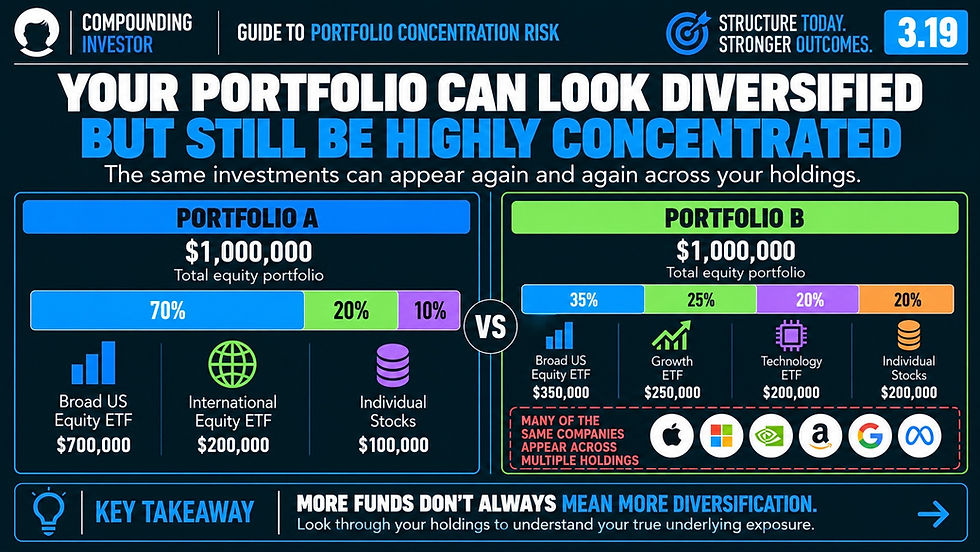
Consider an investor with a $1 million portfolio. Their investments are distributed across five equity funds.
Investment | Portfolio Weight | Value |
S&P 500 ETF | 30% | $300,000 |
Nasdaq-100 ETF | 25% | $250,000 |
Global Equity ETF | 20% | $200,000 |
US Technology ETF | 15% | $150,000 |
Global Growth Fund | 10% | $100,000 |
Total | 100% | $1,000,000 |
The investor owns five funds. Those funds may collectively report thousands of underlying holdings.
But several of the largest companies can appear repeatedly across the portfolio.
The S&P 500 ETF contains major US technology businesses.
The Nasdaq-100 ETF also contains many of those companies.
The global equity ETF includes substantial exposure to the US market.
And the technology ETF deliberately increases exposure to the same sector.
The global growth fund may introduce further overlap.
Consequently, the investor may be allocating capital to the same underlying businesses through several different investment products. The precise concentration cannot be established from fund names alone.
It requires examining the underlying holdings and their respective portfolio weights. This creates a critical distinction:
Fund Diversification ≠ Underlying Investment Diversification
A portfolio may be diversified by product provider, account or fund name without being equally diversified by economic exposure. The appropriate assessment therefore considers several dimensions:
Asset-Class Exposure: How much capital is invested in equities, bonds, cash and other assets?
Geographic Exposure: Which countries and economies ultimately influence portfolio performance?
Sector Exposure: How dependent is the portfolio on particular industries?
Individual Company Exposure: Which businesses represent the largest combined positions?
Holding Overlap: How often do the same underlying investments appear across different funds?
Risk Relationships: How might different investments behave under the same market conditions?
Each dimension reveals something different.
A portfolio can be broadly diversified geographically but concentrated in technology. It can hold many companies while remaining almost entirely exposed to equities. And it can contain defensive investments that provide less protection than expected under particular economic conditions. The framework becomes:
Investment Products → Underlying Holdings → Combined Exposures → Concentration Analysis → Effective Diversification
This approach changes the questions an investor asks.
Instead of asking how many funds they own, they examine the combined exposure those funds create.
Instead of assuming international fund names provide geographic diversification, they calculate the underlying country weights.
And instead of assuming different asset classes will always behave independently, they consider the economic risks affecting each allocation.
For a Structured Compounder, the question is not simply how many investments are held.
It is whether the combined portfolio contains an appropriate distribution of risk across genuinely different sources of investment exposure.
How Many Investments Do You Need for Diversification?
There is no universally correct number of investments required to achieve adequate diversification.
The answer depends on what those investments contain.
A portfolio holding ten individual companies may be considerably more concentrated than one holding a single broadly diversified global equity ETF.
Conversely, an investor holding several global equity funds may gain little additional diversification if those funds contain substantially overlapping investments.
The relevant distinction is between the number of investment products and the number of independent underlying exposures.
Consider three hypothetical equity portfolios.
Portfolio | Investment Structure | Diversification Characteristics |
A | 5 individual shares | Highly dependent on a small number of companies |
B | 30 individual shares across several sectors | Broader company exposure but dependent on security selection |
C | 1 broad global equity ETF | Potential exposure to thousands of companies across multiple markets |
Portfolio C contains the fewest investment products. But it may provide the broadest diversification across individual companies and geographic markets. That does not automatically make it the best portfolio.
The investor must still consider the fund's index construction, geographic weights, sector exposure and concentration in its largest holdings.
The number of securities also matters differently depending on how investments are selected.
Holding 30 companies from the same industry may provide less diversification than holding 15 companies operating across unrelated sectors.
And adding a new investment does not necessarily improve diversification if it behaves similarly to investments already held. This introduces the concept of diminishing diversification benefits.
The first few genuinely different investments can materially reduce dependence on individual companies.
Additional holdings may continue to spread risk. But the incremental benefit generally becomes smaller as exposure broadens, particularly when new holdings resemble existing ones.
More Investments ≠ Proportionately More Diversification
There is also a practical consideration.
Every additional investment can increase monitoring requirements, administrative complexity and the difficulty of understanding total portfolio exposure.
An investor holding 25 funds may need to analyse thousands of underlying positions to establish their actual concentration.
An investor holding three carefully selected funds may have a much clearer view of their investment structure.
This does not mean a three-fund portfolio is automatically superior. It means complexity should serve an identifiable investment purpose.
An additional fund might introduce exposure to a genuinely different asset class, geographic market or investment characteristic.
Alternatively, it might simply duplicate investments already held.
The distinction is whether the new holding contributes something meaningful to the overall portfolio. A useful decision framework is:
Existing Exposure → Proposed Investment → Additional Diversification Benefit → Added Complexity and Cost
The objective is therefore not to maximise the number of holdings. It is to obtain sufficient diversification while maintaining a portfolio that can be understood, monitored and managed consistently.
For a Structured Compounder, the appropriate number of investments is a consequence of portfolio design.
It is not the starting point for deciding whether a portfolio is diversified.
Asset-Class Diversification: Why Different Assets Matter
Asset-class diversification involves distributing capital across investments with different financial characteristics and economic functions.
Equities, bonds, cash and property do not expose investors to identical sources of risk.
Equities provide ownership interests in businesses.
Bonds generally provide contractual payment obligations from issuers.
Cash provides liquidity and relatively stable nominal value, subject to currency, inflation and institutional risks.
Property provides exposure to real estate values and, where applicable, rental income.
These differences matter because asset classes can respond differently to economic conditions.
Consider two investors with $1 million portfolios.
Investor A holds an entirely equity-based portfolio.
Investor B holds a mixture of equities, bonds and cash.
Asset Class | Investor A | Investor B |
Global Equities | 100% | 60% |
Investment-Grade Bonds | 0% | 30% |
Cash | 0% | 10% |
Total | 100% | 100% |
Suppose global equities decline by 30%, bonds increase by 3% and cash generates no return over the period.
Portfolio | Equity Impact | Bond Impact | Cash Impact | Total Portfolio Return | Portfolio Loss |
Investor A | −30.0% | 0% | 0.00% | −30.0% | −$300,000 |
Investor B | −18.0% | 1% | 0.00% | −17.1% | −$171,000 |
Under this illustrative scenario, Investor A experiences a $300,000 loss. Investor B experiences a $171,000 loss. The difference is $129,000.
But this does not establish that bonds will always rise when equities fall. During inflationary shocks or periods of sharply rising interest rates, equities and bonds can decline simultaneously.
Different bond types also carry different levels of duration, credit and inflation risk. The effectiveness of asset-class diversification therefore depends on the underlying characteristics of the investments and the economic conditions affecting them.
This creates an important distinction:
Different Asset Classes ≠ Guaranteed Independent Returns
A portfolio can contain several asset classes without achieving the expected degree of protection in every market environment. Investors must also consider the purpose of each allocation.
Equities → Long-Term Growth Exposure
Bonds → Income, Capital Stability and Potential Diversification
Cash → Liquidity and Near-Term Financial Flexibility
Property → Real Estate Exposure and Potential Rental Income
These are broad functions rather than guaranteed outcomes.
The appropriate allocation depends on investment objectives, time horizon, withdrawal requirements and risk capacity.
For example, an investor accumulating wealth over several decades may prioritise long-term growth.
An investor approaching retirement may place greater emphasis on liquidity and managing the consequences of withdrawing capital during market declines.
Another investor may already have substantial property exposure outside their investment accounts.
For that investor, adding listed property investments could increase rather than reduce overall dependence on real estate.
Asset-class diversification must therefore be considered in the context of the investor's financial circumstances.
Investment Objectives → Risk Capacity → Asset-Class Roles → Strategic Allocation
For a Structured Compounder, asset-class diversification is not simply about holding different categories of investments.
It is about ensuring that each allocation performs a deliberate role within the wider portfolio management system.
Geographic Diversification: Are You More Exposed to the US Than You Think?
Geographic diversification involves spreading investment exposure across different countries and economic regions.
But an investor's geographic exposure is not necessarily determined by where their investment funds are registered, listed or managed.
A UK investor may hold several funds listed on the London Stock Exchange. Yet those funds could invest predominantly in US companies.
Similarly, a global equity ETF may contain substantial US exposure because many of the world's largest listed businesses are American.
The investor may therefore own internationally labelled investments while remaining heavily dependent on the performance of one national equity market.
Consider a $1 million equity portfolio. The investor holds three funds.
Investment | Portfolio Weight | Illustrative US Weight | US Exposure |
S&P 500 ETF | 40% | 100% | $400,000 |
Global Equity ETF | 40% | 65% | $260,000 |
Developed Markets ETF | 20% | 70% | $140,000 |
Total | 100% | $800,000 |
The investor holds three different funds. Two have international investment mandates.
But the combined portfolio has 80% exposure to US-listed equities. The remaining 20% is spread across other markets.
This may be entirely deliberate.
The investor might prefer a market-capitalisation-weighted approach that reflects the substantial representation of US companies in global equity markets. But the important question is whether the exposure is understood and intentional.
Global Fund Ownership ≠ Even Geographic Diversification
There is a second complication.
A company's listing country does not necessarily determine where its economic exposure originates.
A US-listed multinational may generate substantial revenues outside the United States.
A European company may depend heavily on American consumers.
And a business operating internationally may still be influenced by the economic, regulatory and currency conditions of its home market.
Geographic diversification therefore involves more than examining fund labels or stock exchange listings. Investors should distinguish between:
Listing Exposure: Where the underlying securities are listed or classified.
Business Exposure: Where companies generate revenues, earnings and cash flows.
Currency Exposure: Which currencies influence investment values and financial outcomes.
Economic Exposure: Which national or regional conditions affect the underlying businesses.
These dimensions can overlap without being identical.
Currency adds a further consideration.
For an investor whose future spending is denominated in sterling, holding US-dollar assets introduces exchange-rate effects when investment values are measured in pounds.
For an investor whose future spending is denominated in US dollars, the same exposure has different implications.
Neither situation automatically makes international investing unsuitable.
But geographic diversification should be assessed in relation to the investor's wider financial circumstances.
There is also a distinction between geographic diversification and equal geographic allocation.
An investor does not necessarily need to allocate identical proportions of capital to the United States, Europe, Asia and emerging markets.
A global market-capitalisation-weighted fund deliberately allocates more capital to markets containing larger listed companies.
An investor choosing different geographic weights is making an active portfolio allocation decision.
That may be appropriate. But the decision should be understood rather than assumed to provide additional diversification. The framework becomes:
Fund Location → Underlying Market Weights → Business Exposure → Currency Exposure → Geographic Risk
A Structured Compounder does not assume that a portfolio is geographically diversified simply because its funds contain the word global or international.
The investor measures the actual exposure, understands why it exists and decides whether it remains consistent with the intended long-term strategy.
Sector Diversification: The Risk of Hidden Industry Concentration
Sector diversification involves spreading investment exposure across businesses operating in different industries.
But a portfolio containing several funds may still be heavily dependent on one sector. Consider an investor with a $1 million equity portfolio. Their investments are spread across four funds.
Investment | Portfolio Weight | Technology Weight | Technology Exposure |
US Large-Cap ETF | 35% | 35% | $122,500 |
Nasdaq-100 ETF | 30% | 50% | $150,000 |
Global Equity ETF | 25% | 25% | $62,500 |
Technology Sector ETF | 10% | 100% | $100,000 |
Total | 100% | $435,000 |
Although the investor owns four funds, 43.5% of the portfolio is exposed to companies classified within the technology sector.
If that exposure declined by 40% while all other holdings remained unchanged, the portfolio would lose $174,000.
The concentration is not necessarily inappropriate. But it should be understood.
There is also a distinction between formal sector classifications and economic exposure.
Digital advertising companies may be classified within communication services. Online retailers may sit within consumer discretionary.
Yet these businesses can still be influenced by similar technology trends, valuations and economic conditions.
Sector Classification ≠ Independent Economic Risk
A structured sector review therefore considers:
Combined exposure to each industry.
Whether several funds increase the same sector allocation.
Whether different sectors depend on similar economic drivers.
The potential portfolio impact of a significant sector decline.
The objective is not to allocate equally across every industry. It is to ensure that sector concentration reflects a deliberate investment decision.
Fund Holdings → Combined Sector Exposure → Concentration Assessment
For a Structured Compounder, sector diversification is measured across the consolidated portfolio rather than inferred from individual fund descriptions.
Portfolio Overlap: When Different Funds Own the Same Investments
Portfolio overlap occurs when multiple investment funds hold the same underlying securities.
It is particularly relevant to investors combining ETFs, index funds and actively managed funds. A portfolio might contain an S&P 500 ETF, Nasdaq-100 ETF, global equity fund and US growth fund.
Each has a different investment description. But several large companies may appear in all four.
Consider a $1 million portfolio.
Investment | Portfolio Weight | Company X Weight | Exposure to Company X |
S&P 500 ETF | 35% | 7% | $24,500 |
Nasdaq-100 ETF | 30% | 9% | $27,000 |
Global Equity ETF | 25% | 5% | $12,500 |
US Growth Fund | 10% | 10% | $10,000 |
Total | 100% | $74,000 |
The investor does not own Company X directly. Yet the combined funds create a $74,000 position, representing 7.4% of the portfolio.
If Company X declined by 50%, the direct impact would be a $37,000 portfolio loss, assuming all other holdings remained unchanged.
The investor may believe that four funds provide four independent sources of diversification. But the underlying exposure reveals something different.
Multiple Funds ≠ Multiple Independent Investments
An investor may deliberately increase exposure to particular companies or markets. The important distinction is whether the combined position is intentional. A useful calculation is:
Effective Company Exposure = Sum of Each Fund's Portfolio Weight × Company's Weight Within That Fund
This look-through approach identifies the largest underlying holdings across the portfolio.
It also reveals whether adding another fund introduces genuinely different investments or simply increases existing positions.
Fund Holdings → Look-Through Analysis → Combined Company Weights
For a Structured Compounder, diversification is assessed after consolidating overlapping investments, not by counting the number of funds owned.
Correlation Explained: Why Investments Can Fall Together
Correlation measures how closely the returns of two investments have historically moved together.
It matters because investments that appear different may respond similarly to the same economic conditions.
Correlation is commonly expressed between −1 and +1.
Correlation | Interpretation |
1 | Perfect positive linear relationship |
0.7 | Strong positive relationship |
0 | No linear relationship |
−0.7 | Strong negative relationship |
−1.0 | Perfect negative linear relationship |
A correlation of +1 means returns move together proportionally, not necessarily by identical percentages.
correlation of zero does not mean investments are independent or risk-free.
The diversification benefit arises when investments do not move perfectly together.
Consider two investments with identical annual volatility of 20%, held in equal proportions.
Correlation | Illustrative Portfolio Volatility |
100% | 20.00% |
50% | 17.30% |
0 | 14.10% |
−0.5 | 10.00% |
Calculated using the standard two-asset portfolio variance formula, assuming equal weights and identical asset volatility.
The investments have not individually become less risky. But their combined portfolio volatility changes because their returns behave differently.
Asset Weights + Individual Volatility + Correlation → Portfolio Volatility
However, historical correlations are not fixed. Equities and bonds can both decline during periods of rising inflation and interest rates.
International equity markets may also become more closely correlated during global financial stress.
This means diversification relationships that appeared effective under normal conditions may provide less protection during a crisis.
Historical Correlation ≠ Guaranteed Future Diversification
A Structured Compounder uses correlation to understand how investments interact, while recognising that those relationships can change.
Concentration Risk: How Individual Holdings Can Dominate Portfolio Outcomes
Concentration risk arises when a relatively small number of investments account for a disproportionately large share of portfolio value or risk.
A portfolio can contain hundreds of companies while remaining heavily dependent on its largest holdings.
This is particularly relevant to market-capitalisation-weighted index funds, where larger companies receive greater weights.
Consider two $1 million equity portfolios. Both contain 100 companies.
Portfolio Characteristic | Portfolio A | Portfolio B |
Number of Companies | 100 | 100 |
Weight of Five Largest Holdings | 45% | 15% |
Weight of Remaining Holdings | 55% | 85% |
Value of Five Largest Holdings | $450,000 | $150,000 |
Suppose the five largest companies decline by 40%, while all other holdings remain unchanged.
Portfolio A loses $180,000.
Portfolio B loses $60,000.
The difference is $120,000, despite both portfolios containing the same number of companies.
Number of Holdings ≠ Distribution of Portfolio Risk
A successful company may grow from 5% to 15% of the portfolio.
Alternatively, overlapping funds may create a large combined position in one business. A structured concentration review examines:
The largest individual company weights.
Combined exposure through different funds.
The percentage represented by the five or ten largest holdings.
Whether market movements have materially changed concentration.
Whether the exposure remains consistent with risk capacity.
Concentration is not automatically a mistake. But it should be measured and understood.
Position Weights → Combined Exposure → Portfolio Concentration
For a Structured Compounder, the objective is not to eliminate every large holding, but to ensure that no unintended concentration dominates the investment strategy.
Diversification Beyond Investments: Property, Pensions and Wider Wealth
Portfolio diversification is often assessed through the investments held within a brokerage account.
But an investor's wider financial position may contain substantial exposure to property, pensions, private businesses and other assets.
These exposures can materially change the overall risk profile. Consider a retired investor with $3.2 million in gross assets.
Asset | Value | Share of Total Assets |
Global Equities | $800,000 | 25.00% |
Bonds | $400,000 | 12.50% |
Cash | $200,000 | 6.25% |
Rental Properties | $1,400,000 | 43.75% |
Main Residence | $400,000 | 12.50% |
Total | $3,200,000 | 100% |
Looking only at the $1.4 million financial investment portfolio, the investor holds approximately 57% equities, 29% bonds and 14% cash. But property represents 56.25% of total gross assets.
The investor therefore has substantial exposure to property values, rental demand, maintenance costs and local economic conditions.
Owning several rental properties does not necessarily eliminate this concentration, particularly when those properties operate in the same geographic market.
Investment Portfolio Diversification ≠ Total Wealth Diversification
Pensions introduce another consideration.
Defined contribution pensions contain underlying investments that should generally be included in consolidated portfolio analysis.
Defined benefit pensions provide retirement income entitlements and require a different assessment, including income security and inflation protection.
Business ownership can also create substantial sector concentration. An investor whose wealth depends heavily on one private business may already have considerable exposure to that industry.
A complete financial review therefore considers:
Investment Accounts → Pensions → Property → Business Interests → Liabilities → Net Wealth
Not every asset needs to be managed as part of a tradable investment portfolio. But wider assets, income dependencies and liabilities should inform decisions about investment risk.
For a Structured Compounder, diversification is assessed both within the financial investment portfolio and across the wider financial position.
How to Measure and Monitor Your Portfolio Diversification
Measuring diversification requires investors to look beyond fund names and headline asset allocation percentages.
The starting point is a consolidated view of all relevant investment accounts. This allows underlying exposures to be measured across the entire portfolio rather than account by account.
A structured diversification review should examine five dimensions.
Dimension | What to Measure | Key Question |
Asset Classes | Equities, bonds, cash and other assets | Is capital distributed appropriately across different investment functions? |
Geography | Country and regional exposure | Is the portfolio excessively dependent on particular markets? |
Sectors | Combined industry weights | Are a small number of sectors dominating exposure? |
Individual Holdings | Look-through company weights and fund overlap | Which businesses represent the largest effective positions? |
Risk Relationships | Volatility, correlation and concentration | How might investments behave together under different market conditions? |
Each dimension reveals information that the others cannot fully capture.
For example, a portfolio might have broad geographic exposure but remain heavily concentrated in technology.
Or it might contain hundreds of companies while depending disproportionately on its largest holdings.
One useful measurement is the combined weight of the largest underlying investments.
Consider the following consolidated equity exposures.
Underlying Holding | Portfolio Weight |
Company A | 8% |
Company B | 7% |
Company C | 6% |
Company D | 5% |
Company E | 4% |
All Other Holdings | 70% |
Total | 100% |
The five largest companies represent 30% of the equity portfolio.That does not automatically mean diversification is inadequate. But it identifies a measurable concentration that can be reviewed over time.
A further measure is the effective number of holdings, calculated using the squared weights of individual securities.
Effective Number of Holdings = 1 ÷ Sum of Squared Holding Weights
Ten equally weighted companies have an effective holding count of ten.
Ten companies with one dominant position have a lower effective count.
However, this measure does not account for correlation or shared economic exposure, so it should not be used in isolation.
Diversification also changes as markets move, funds alter their holdings and individual positions grow. A repeatable monitoring process is therefore essential.
Consolidate Holdings → Calculate Exposures → Identify Concentrations → Compare Against Portfolio Rules → Review Changes
Monitoring does not automatically require trading.
An increase in technology exposure, for example, may warrant a review without necessarily justifying immediate rebalancing.
The decision should reflect strategic allocation, risk capacity, transaction costs and tax implications.
For a Structured Compounder, the objective is not perfect diversification. It is a portfolio whose underlying exposures are understood, measurable and consistently managed.
Discover What Your Portfolio Diversification Reveals About You
Owning multiple funds, shares and asset classes doesn’t automatically mean you have a genuinely diversified investment portfolio.
The important question is whether your investments provide exposure to different sources of risk — or whether overlapping holdings, sector concentration and geographic dependencies are creating greater exposure than you realise.
The Free Investor Assessment helps identify:
portfolio diversification and concentration blind spots
whether your current investments reflect deliberate diversification decisions or accumulated and overlapping exposures
whether your asset allocation, sector weights and geographic exposures are consistent with your investment objectives
your current Investor Progression Model stage
practical next steps towards becoming a Structured Compounder
Because successful portfolio diversification isn’t about owning as many different investments as possible or assuming that multiple funds automatically provide protection against market declines.
It’s about understanding what you actually own, how your investments behave together and whether your portfolio is unnecessarily dependent on particular companies, sectors, markets or economic conditions.
And once those exposures are understood, you can make far better decisions about portfolio construction, concentration risk, asset allocation, diversification and long-term compounding.
Only takes 2-minutes • manually reviewed • delivered within 24 hours
The Retired Advertising Executive Who Owned a Diversified Portfolio but Had Concentrated His Wealth
The Investor was a 62-year-old British television advertising executive who had spent more than three decades working with major broadcasters and advertising agencies in London.
Following retirement, he and his American wife relocated to Sarasota, Florida, her hometown, where they planned to combine retirement with managing a portfolio of Airbnb rental properties.
The move represented a significant lifestyle change. They had accumulated substantial wealth through their careers, property ownership and long-term investing.
Their financial investments were spread across global equity funds, bonds and cash.
And they believed their overall financial position was well diversified.
But a closer examination revealed that the diversification within their investment accounts did not reflect the concentration across their total wealth.
The Investment Strategy That Appeared to Be Diversified
The couple had established a $1.5 million financial investment portfolio. Their allocation was:
Global Equities → 60%
Bonds → 30%
Cash → 10%
The Investor reviewed their investments regularly and had deliberately avoided holding large positions in individual companies.
Their equity exposure was distributed across global markets.
Their bonds provided income and a defensive allocation.
And their cash reserves supported near-term expenditure.
Alongside these investments, the couple owned four Airbnb rental properties in the Sarasota area and their principal residence. Their consolidated assets were:
Asset | Value | Share of Total Assets |
Global Equities | $900,000 | 18% |
Bonds | $450,000 | 9% |
Cash | $150,000 | 3% |
Four Airbnb Properties | $2,000,000 | 40% |
Principal Residence | $1,500,000 | 30% |
Total Assets | $5,000,000 | 100% |
The couple held $5 million in gross assets. Their financial portfolio appeared diversified.They also owned five separate properties.
But the combined figures revealed a different picture.

What The Review Revealed
The financial investment portfolio represented just 30% of the couple's total gross assets. The remaining 70% was invested in residential property.
Of that property exposure, $2 million was concentrated in four short-term rental properties operating within the same local market. The couple therefore had substantial dependence on:
Sarasota property values.
Local tourism and short-term rental demand.
Property insurance and maintenance costs.
Local regulations affecting holiday accommodation.
The availability and cost of property management services.
The four Airbnb properties were separate buildings. But they were not four independent sources of economic risk.
A decline in Sarasota tourism, increased insurance premiums or changes in local short-term rental regulations could affect several properties simultaneously.
The Investor had diversified the number of properties owned. But not the geographic market or business model supporting their rental income.
Multiple Properties ≠ Diversified Property Risk
The Real Issue
The problem was not that the couple had invested in Airbnb properties.Nor was it necessarily inappropriate to own substantial real estate. The properties were part of their intended retirement lifestyle and income strategy.
The issue was that their assessment of diversification had focused primarily on the financial investment portfolio.
They had considered the $1.5 million portfolio separately from their $3.5 million residential property holdings.
This created a misleading impression of their overall financial position. Their financial investments were reasonably diversified across asset classes.
But their total wealth remained heavily dependent on residential property, with substantial exposure to one geographic area.
There was also a potential connection between asset values and retirement income. If Sarasota property conditions deteriorated, the couple could experience declining rental income alongside falling property values and increased operating costs. That could increase the need to withdraw capital from their financial investments.
Diversified Investment Accounts ≠ Diversified Total Wealth
The relevant question was therefore not whether their global equity funds contained enough companies.
It was whether the combined financial structure provided sufficient resilience to support their retirement objectives.
What Changed
The Investor began reviewing the couple's financial position as one consolidated system. Rather than focusing exclusively on their brokerage accounts, the review incorporated their property holdings, rental income, cash reserves and expected retirement expenditure.
The couple established a clearer distinction between:
Financial Investments → Long-Term Growth, Income and Liquidity
Airbnb Properties → Rental Income and Concentrated Local Property Exposure
Principal Residence → Housing Security and Property Wealth
They also recognised that gross asset values did not establish their complete financial position.
Any mortgages, liabilities and ongoing property commitments needed to be considered alongside net wealth and cash flow.
The review did not automatically lead to selling properties or reducing their financial investments.
Instead, it established a more deliberate approach to monitoring their exposure. The couple began assessing rental income sensitivity, local property concentration and liquidity requirements alongside their financial portfolio.
This changed the way the Investor understood diversification. Previously, he had asked:
“Are our investments diversified across enough funds and asset classes?”
The more important question became:
“How much of our total wealth and retirement income depends on the same property market, and do our financial investments provide sufficient flexibility if those conditions change?”
The distinction was significant. Diversification was no longer measured solely by the number of investments, funds or properties owned.
It was assessed through the combined economic risks affecting their overall financial position.
Investment Diversification → Total Wealth Exposure → Income Dependence → Financial Resilience
The Investor had moved from viewing diversification as a characteristic of individual investment accounts towards understanding it as part of a wider portfolio management system.
That is the transition towards becoming a Structured Compounder.
The Investor Progression Model: From Owning More Investments to Understanding Portfolio Risk
Portfolio diversification is not simply about how many funds, shares or asset classes an investor owns.
It is about understanding how those investments interact and whether the combined portfolio provides an appropriate distribution of risk.
Two investors may hold identical investments but approach diversification very differently.
One may have accumulated funds over time without examining their underlying exposures.
Another may have deliberately constructed a portfolio around asset allocation, geographic diversification, sector weights and concentration limits.
The difference is not necessarily the investments themselves.
It is the decision-making process behind them. The Investor Progression Model helps explain this distinction.
An early-stage investor asks:
“How many investments should I own to be diversified?”
A developing investor asks:
“Am I spread across enough funds, sectors and countries?”
A more structured investor asks:
“Where are my largest underlying exposures, and how much overlap exists between my investments?”
A Structured Compounder asks:
“Does my combined portfolio provide the diversification required by my long-term objectives, risk capacity and wider financial position?”
These questions reflect a progression from measuring diversification through investment quantity towards understanding and controlling the risks within the portfolio.
Count Investments → Spread Across Assets → Identify Overlap → Control Concentration → Monitor Total Exposure
The progression is not about continually adding more investments. It is about developing a more deliberate approach to portfolio construction. Consider the following questions:
Do you know your portfolio’s combined exposure to its five largest underlying companies?
Have you examined whether different ETFs and investment funds contain overlapping holdings?
Do you understand your actual geographic exposure rather than relying on fund names?
Have you calculated how much of your portfolio depends on particular sectors?
Do you understand how correlations can affect diversification during market declines?
Have you considered property, pensions and business ownership when assessing your wider financial exposure?
Do you have clear rules for identifying and reviewing excessive concentration?
Can you explain why each investment contributes something meaningful to your overall portfolio?
The answers help reveal how deliberately diversification is being managed.
A Reactive Investor may respond to market developments by adding funds, switching sectors or buying investments that appear to offer greater diversification. But these decisions are often made without examining existing exposures.
A Lucky Investor may own a broadly diversified portfolio through a small number of well-chosen funds. The underlying structure may be effective, but the investor has not necessarily established a repeatable process for understanding or maintaining it.
A Conservative Compounder may deliberately spread capital across asset classes and geographic markets, avoiding obvious concentration. However, they may not consistently measure fund overlap, underlying company weights or the relationship between their investment portfolio and wider wealth.
A Structured Compounder goes further. They understand the portfolio’s underlying exposures, assess concentration across investments and wider assets, and maintain a repeatable process for reviewing whether diversification remains appropriate.
The objective is not perfect diversification.
Nor is it to eliminate every investment risk.
It is to ensure that the portfolio’s structure reflects deliberate decisions rather than assumptions based on the number of holdings.
Because genuine diversification is not established by how many investments you own — but by understanding the risks you own together.

Common Portfolio Diversification Mistakes
Diversification mistakes often arise because investors assess their holdings individually rather than examining how those investments interact. Some of the most common include:
Confusing the number of funds with diversification. Owning ten ETFs does not necessarily provide more diversification than holding three, particularly when their underlying investments overlap.
Ignoring individual company concentration. A portfolio containing hundreds of shares may still depend heavily on a small number of large companies.
Assuming global funds provide balanced geographic exposure. Market-capitalisation-weighted global funds can contain substantial US exposure, even when their investment mandate covers multiple countries.
Overlooking sector concentration. Several funds may collectively create significant exposure to technology, financial services or another industry.
Treating different asset classes as completely independent. Equities and bonds can decline simultaneously, particularly when inflation and interest-rate conditions affect both.
Ignoring wider wealth. Property, pensions and business interests can create substantial economic exposure that is not visible within an investment account.
Adding investments without assessing their contribution. A new fund may increase complexity and costs without introducing meaningful diversification.
Failing to monitor changing exposures. Market movements can increase the weight of successful investments, gradually creating concentrations that were not part of the original strategy.
The common problem is not necessarily poor investment selection. It is the absence of a consolidated understanding of portfolio risk.
More Investments → More Complexity, Unless They Add Meaningful Diversification
A Structured Compounder evaluates what each investment contributes to the overall portfolio rather than assuming additional holdings automatically improve its structure.
Portfolio Diversification Methods Comparison
There are several ways to assess diversification. Each provides a different perspective on how portfolio risk is distributed.
Investment-Count Diversification | Underlying-Exposure Diversification |
Focuses on the number of funds, shares and investment products owned | Focuses on the combined economic exposures created by those investments |
Assumes additional holdings generally improve diversification | Assesses whether additional holdings introduce genuinely different sources of risk |
Measures diversification primarily through investment quantity | Measures diversification through asset classes, sectors, geography and underlying holdings |
May overlook companies appearing repeatedly across multiple funds | Identifies overlapping holdings and calculates combined company exposure |
Can appear geographically diversified through international fund names | Examines actual country weights and underlying geographic exposure |
May underestimate concentration within particular industries | Calculates combined sector weights and identifies dominant exposures |
Does not necessarily consider how investments behave together | Considers correlations and common economic risk factors |
May assess investment accounts separately | Consolidates relevant accounts and considers wider financial exposure |
Can become more complex as additional funds are accumulated | Aims for sufficient diversification without unnecessary investment complexity |
The distinction is not that holding multiple investments is inherently ineffective.
Broadly diversified funds can provide substantial diversification through a relatively small number of investment products.
But the number of holdings alone cannot establish how effectively risk is distributed.
Investment Quantity → Apparent Diversification
Underlying Exposure Analysis → Measurable Diversification
For a Structured Compounder, the objective is to understand whether the combined portfolio provides an appropriate distribution of risk, rather than simply accumulating more investments.
Quick Portfolio Diversification Audit
Ask yourself:
✓ Do you know your current allocation across equities, bonds, cash and other asset classes?
✓ Have you consolidated your investments across all relevant accounts?
✓ Do you know your portfolio's five largest underlying company exposures?
✓ Have you checked whether your ETFs and investment funds hold the same companies?
✓ Do you understand your actual exposure to US equities?
✓ Have you calculated your combined sector allocations?
✓ Do you know whether your portfolio is concentrated in particular industries or economic themes?
✓ Have you considered how your investments might behave together during market stress?
✓ Do you understand the contribution of your largest holdings to overall portfolio risk?
✓ Have you considered property, pensions and business ownership within your wider financial position?
✓ Do you have a process for identifying changes in portfolio concentration?
✓ Can you explain why each investment contributes meaningfully to your long-term strategy?
These questions are not designed to produce a perfect diversification score.
They are intended to reveal whether diversification is being measured and managed deliberately.
An investor who cannot answer several of them may have a portfolio that appears diversified without understanding its underlying exposure.
The next step is not necessarily to buy or sell investments. It is to establish a clearer picture of the portfolio's actual structure.
Measure Exposure → Identify Concentration → Assess Risk → Decide Whether Action Is Necessary
That is the foundation of a disciplined diversification process.
Who This Guide Is For
This guide is particularly relevant to investors who:
✓ Hold several ETFs, mutual funds or individual shares.
✓ Want to understand whether their investments overlap.
✓ Are concerned about hidden technology or US market concentration.
✓ Have accumulated investments across multiple accounts.
✓ Want to assess diversification beyond headline asset allocation.
✓ Hold significant property or business assets alongside financial investments.
✓ Are approaching retirement and reviewing their financial resilience.
✓ Want to understand how correlation affects portfolio risk.
✓ Are seeking a clearer process for monitoring concentration.
✓ Want to progress towards becoming a Structured Compounder.
The guide is particularly useful for investors who already have a portfolio but are uncertain whether its structure reflects deliberate diversification decisions.
It is also relevant to investors whose wealth has grown across different assets without a consolidated review of their combined financial exposure.
The objective is to move from assuming a portfolio is diversified towards understanding why it is diversified.
Who This Guide Is NOT For
This guide is not intended for investors who:
Want a list of shares or ETFs guaranteed to outperform the market.
Believe diversification can eliminate the possibility of investment losses.
Are seeking short-term trading signals or market-timing strategies.
Want a universally correct number of funds or individual holdings.
Expect every asset class to perform independently during market declines.
Are looking for a formula that guarantees protection against financial crises.
Want to maximise returns without considering concentration or downside risk.
Diversification is a portfolio construction and risk-management discipline. It cannot guarantee positive returns or prevent losses.
Its purpose is to reduce unnecessary dependence on particular investments and economic outcomes while supporting a coherent long-term strategy.
Discover What Your Portfolio Diversification Reveal About You
Most investors can identify the investments they own. They can see:
Individual shares and investment funds
Portfolio allocation percentages
Equity, bond and cash holdings
Geographic and sector exposure
Their largest individual positions
Yet many still cannot answer some of the most important questions about their overall portfolio structure.
Are my investments genuinely diversified, or do several funds hold the same companies?
How much of my portfolio depends on US equities and large technology businesses?
Are different investments exposing me to the same underlying economic risks?
Is my portfolio more concentrated than its asset allocation suggests?
How do property, pensions and other assets affect my total financial exposure?
What stage of the Investor Progression Model am I currently at?
What should I change to become a more structured long-term investor?
Your portfolio may already appear well diversified across multiple investments. But spreading capital across different holdings isn't the same as understanding what your portfolio ultimately depends on.
The Free Investor Assessment helps identify:
Hidden weaknesses in your portfolio diversification and risk structure
Whether your investments reflect deliberate decisions or accumulated overlapping exposures
Potential gaps in your approach to asset allocation, concentration and portfolio monitoring
Your current Investor Progression Model stage
Practical next steps towards becoming a Structured Compounder
Takes Less Than 2-Minutes
FAQs
How do I know if my investment portfolio is properly diversified?
A diversified portfolio spreads exposure across different investments and sources of economic risk. Assess asset classes, geographic and sector weights, underlying company concentration and fund overlap. The appropriate level of diversification depends on your investment objectives, time horizon and risk capacity.
How many stocks do you need for a diversified portfolio?
There is no universally correct number. Holding 30 individual companies across different industries may provide greater diversification than holding 30 closely related businesses. A single broad equity ETF may also provide exposure to thousands of companies, although it remains subject to equity-market risk.
Can you be over-diversified?
Yes. Adding investments can eventually provide little additional diversification while increasing complexity, costs and monitoring requirements. The objective is not to maximise holdings but to ensure that each investment contributes meaningfully to the overall portfolio.
Is owning several ETFs enough to diversify a portfolio?
Not necessarily. Multiple ETFs can hold many of the same companies. Investors should examine their combined underlying holdings rather than assuming that different fund names provide independent exposure.
What is portfolio overlap?
Portfolio overlap occurs when different funds hold the same underlying securities. It can create larger combined positions in individual companies or sectors than an investor realises. Overlap is not automatically undesirable, but it should be understood.
Does a global equity ETF provide geographic diversification?
A broad global equity ETF can provide exposure to companies across numerous countries. However, market-capitalisation weighting can create substantial concentration in larger markets, particularly the United States. Global exposure does not necessarily mean evenly distributed geographic exposure.
Why do diversified investments sometimes fall together?
Different investments can respond to common economic conditions, including interest rates, inflation and changes in investor confidence. Correlations can also increase during financial stress, reducing the diversification benefits investors previously experienced.
Should property be included when assessing portfolio diversification?
Property should be considered when assessing wider wealth and financial risk. Significant property holdings may create exposure to local markets, rental income and operating costs. However, a principal residence serves a different purpose from a tradable financial investment.
Does diversification reduce investment returns?
Diversification can reduce exposure to the best-performing individual investment, but it can also limit dependence on the worst-performing holdings. Its primary purpose is to manage concentration and portfolio risk rather than maximise returns in every market environment.
How often should you review portfolio diversification?
A scheduled annual review can provide a useful starting point, supplemented by checks following material changes in portfolio holdings, financial circumstances or market concentration. The appropriate frequency depends on portfolio complexity and the investor's established monitoring rules.
Explore The Full Framework
The Investor Progression Model White Paper |
This guide forms part of the Compounding Investor Progression Model—a framework designed to help investors move from reactive decision-making towards a repeatable, structured investment process. Inside the white paper you’ll discover: ✓ The four investor types ✓ Why most investors plateau ✓ The five dimensions of investor progression ✓ How Structured Compounders build repeatable systems ✓ The research behind the Investor Assessment |
⬇ READ THE WHITE PAPER ⬇ |
Related Articles
Continue Building Your Portfolio Management System
Understand what portfolio declines reveal about investment risk and the losses an investor may need to withstand.
Explore how investment time horizons, retirement objectives and risk capacity influence portfolio construction.
Explore how portfolio weighting determines how much influence individual investments have over overall outcomes.
Understand how much international exposure your portfolio actually contains and whether that weighting is deliberate.
Look through funds and individual holdings to identify where portfolio risk may be more concentrated than it first appears.
Learn how to distinguish restoring strategic allocation targets from deliberately changing portfolio exposure in response to market conditions.
Explore calendar-based and threshold-based rebalancing approaches for controlling portfolio drift and maintaining intended risk exposure.
Final Thought
How diversified is your investment portfolio really?
The answer is not determined by how many shares, ETFs or investment funds you own.
An investor holding twenty funds may still have substantial exposure to the same companies, sectors and geographic markets.
Another holding just three carefully selected funds may achieve broader diversification with considerably less complexity.
The difference is not necessarily the number of investments.
It is the underlying exposure those investments create when considered together.
Effective portfolio diversification requires understanding:
Asset Allocation: How capital is distributed across equities, bonds, cash and other investments.
Underlying Exposure: Which companies, sectors and geographic markets ultimately influence portfolio performance.
Risk Relationships: How different investments may behave together, particularly during periods of market stress.
Wider Wealth: How property, pensions, business interests and other assets affect overall financial exposure.
But diversification is not about eliminating every concentration. Some exposures may be deliberate. Others may reflect the structure of global investment markets.
And some may be appropriate given the investor’s financial objectives, time horizon and capacity to withstand losses.
The important distinction is whether those exposures are understood and form part of a deliberate investment strategy.
A Structured Compounder does not continually add investments simply to increase the number of holdings.
Nor do they assume that owning several funds automatically protects their portfolio against market declines.
Instead, they understand what their investments actually contain, measure how those exposures interact and establish a repeatable process for monitoring concentration.
That process allows diversification decisions to be made within a wider framework of asset allocation, risk management and long-term compounding.
Because successful diversification is not about owning everything.
It is about understanding what you own, why you own it and which risks you are accepting.
And sometimes, the most effective diversification decision is not to buy another investment — but to understand the investments you already have.


Comments